
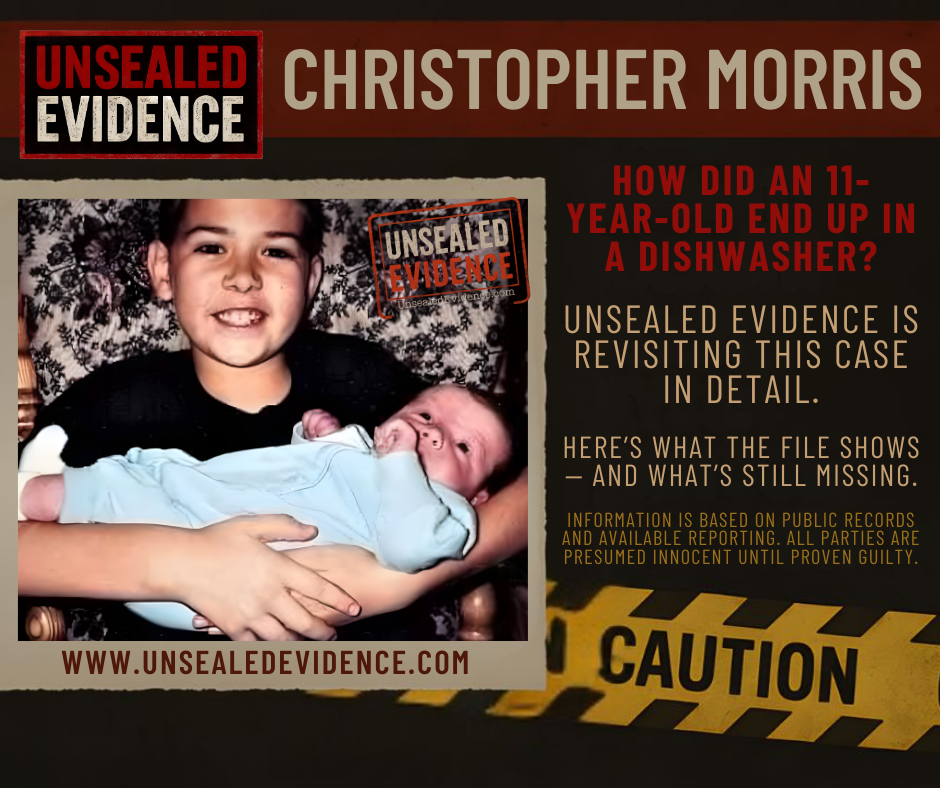
The Boy in the Dishwasher: The Unanswered Death of Christopher Aaron Morris
The Day Everything Changed on Sheppard Air Force Base
On paper, September 25, 2000 should have been an ordinary fall break Monday on Sheppard Air Force Base in Wichita Falls, Texas. Kids were off school. Parents were at work. The base housing streets were full of bikes, footballs, and bored military kids trying to stretch a day off into something interesting.
Eleven-year-old Christopher Aaron “Topher” Morris was one of those kids.
He lived with his dad, Staff Sergeant Carl Morris, and his stepmother in base housing on Century Avenue in the Capehart neighborhood. His little sister Ashley wasn’t there that day. It was just Christopher and the quiet house.
Christopher was a fifth grader at John G. Tower Elementary. He loved football, Power Rangers, Legos, and hanging out with his sister. People who knew him describe a kid who was energetic, sweet, a little absentminded sometimes, but deeply caring. The kind of child who didn’t like people fighting, who wanted everyone around him to be okay.
That morning, his dad did what a lot of military parents did on a “safe” base: he went to work, trusting that his 11-year-old son could handle a few hours alone at home during break. At some point late morning, Carl came home for lunch. According to accounts shared over the years, he found Christopher alive, fine, doing normal kid things. They spent a little time together. Then Carl went back to work.
The next time he walked through that front door, his life – and Christopher’s story – changed forever.
When Carl came home again that afternoon, the house didn’t feel right. The normal sound of Christopher running to greet him never came. The rooms were too still. As he searched, something strange caught his eye: the dishwasher racks, pulled out of the machine and placed somewhere they didn’t belong – in Christopher’s bedroom or on a bed, depending on which retelling you read.
Then he saw Christopher’s clothes, piled near the kitchen dishwasher.
When he opened that dishwasher door, he found his son’s nude body inside, lifeless.
At some point while he had been gone, a full wash cycle had allegedly run with Christopher in the machine.
Emergency responders were called. Military police, local law enforcement, and federal agents became involved. The quiet routine of Sheppard Air Force Base was shattered by a death so bizarre and brutal that people still struggle to believe it really happened.
And yet, more than two decades later, no one has ever been charged, the cause of death is still described as undetermined, and the case has quietly slipped into the shadows — kept alive mostly by grieving family members, scattered local reporting, and pockets of internet communities who refuse to let Christopher’s name disappear.
Remembering Christopher Beyond the Dishwasher
Before anything else, Christopher was a child — not a mystery, not a headline, not a Reddit rabbit hole.
He was born March 3, 1989, in Del Rio, Texas. He later moved with his family into military housing at Sheppard Air Force Base in Wichita County. He was described as:
- A boy who loved football
- Obsessed with Power Rangers and Legos
- A big brother who adored his little sister, Ashley
- A kid who always wanted people to get along and be okay
Classmates and relatives have remembered him as funny, kind, warm, and trusting. An “all energy” kind of kid who filled rooms with noise and life.
He attended John G. Tower Elementary School in nearby Burkburnett, Texas. By all accounts, he was well-liked at school. Some unconfirmed blog comments have claimed he had trouble with older kids at one point, but those statements have never been verified by official sources, and should be treated as rumor, not established fact.
Christopher’s parents were separated. He lived primarily with his father, Carl, and his stepmother, Kelly, on base. His mother, identified in various write-ups as Shirlee or Cheryl Shatley, lived elsewhere but still had contact with him.
His younger sister Ashley McCarthy has become one of the only consistent, public voices for the family, speaking about the case years later to try to correct misinformation and make sure the world understands that a real little boy was lost — not just some “creepy case” for people to tell stories about.
If Christopher had lived, he would be in his thirties today. Instead, everything people know about him is filtered through one horrifying moment with a dishwasher and a case file that never gave his family the answers they deserved.
A Case the Internet Almost Erased
With a death this strange — an 11-year-old found nude inside a dishwasher on a U.S. military base — you would expect wall-to-wall media coverage, decades of documentaries, books, and deep dives.
That didn’t happen here.
Most of what we know about Christopher’s death comes from:
- A base newspaper article and a few pieces of local reporting
- A later true crime podcast episode that interviewed his sister
- A handful of Facebook posts, memorial pages, and archived discussions
- An obscure feminist blog from the mid-2000s whose comment section was flooded with messages about Christopher
- Later internet write-ups and Reddit posts trying to piece everything together
There are no widely available police press conferences, no complete, public autopsy report, and almost no preserved mainstream coverage. Some people online have even questioned whether the case really happened at all – until they stumble across Christopher’s obituary, burial records, and the scattered local reporting that confirms he existed, and that he really did die on September 25, 2000.
That lack of information has helped fuel speculation, rumor, and outright misinformation:
- Early online retellings claimed he was tortured and sexually assaulted.
- Some claimed his body was mutilated.
- Others repeated details about the dishwasher being still running when his father arrived, or his clothes being folded “just so.”
According to his sister Ashley and people who have actually seen parts of the official file, many of those graphic claims are not supported by the reports. Ashley has stated that there was no evidence of sexual assault or ritualized torture, and that some online accounts have turned her brother’s death into something more sensational than the family believes is accurate.
At the same time, certain details — like the unknown handprint on the dishwasher that reportedly did not match any family member — appear again and again in multiple independent retellings. So does the fact that Christopher’s clothing was found outside the machine, and that the dishwasher racks had been removed and placed somewhere else in the home.
And hovering over all of it is the same aching reality:
Despite how shocking this case is, it was never fully explained, and it quietly faded from public view.
In later years, people on Reddit and in niche blogs started calling it “the boy in the dishwasher” case and treating it almost like an internet urban legend — which, in its own way, is another erasure of Christopher’s real life and the real pain his family has carried for twenty-five years.
What Official Accounts Have Actually Described
When you strip away the rumors, the repeated, unverified social media claims, and the internet telephone game, the core of the case looks like this:
Date of death: September 25, 2000
Location: Family home in base housing at Sheppard Air Force Base, Wichita Falls area, Texas
Victim: 11-year-old Christopher Aaron “Topher” Morris
The day of the incident
According to consistent accounts that claim to rely on police reporting and interviews with the family:
- Christopher was home from school on fall break.
- His father believed he was mature enough to be left alone for a few hours.
- Around late morning, Carl came home for lunch. Christopher was alive and well. Carl later returned to work.
- Sometime in the afternoon, Carl came home again — different sources put this between roughly 2:00 p.m. and 4:30 p.m.
- When he walked in, the house was quiet. Christopher did not come running to greet him as usual.
- Carl noticed that the dishwasher racks had been removed and moved to a bedroom or bed.
- In the kitchen, he saw Christopher’s clothes — the ones he had been wearing — placed next to the dishwasher.
- When Carl opened the dishwasher, he found Christopher’s nude body inside.
Some accounts say the dishwasher had already completed a full cycle, leaving Christopher’s body wet and injured. There is disagreement over whether those injuries came from the dishwasher cycle itself or from some other event.
The investigation
Responders reportedly included:
- Air Force military police
- Local Wichita Falls law enforcement
- Federal investigators
From the very beginning, suspicion appears to have focused on Christopher’s father. Ashley has said that the military police immediately treated him as if he were responsible. He was questioned, scrutinized, and looked at as a potential suspect.
Despite that, no charges were ever filed against Carl Morris. Over time, Ashley has publicly defended her father and said she believes his grief and shock were genuine, and that he was wrongfully treated as the primary suspect while other possible avenues were not fully explored.
Some key points that have surfaced through reporting and later commentary:
- Christopher’s cause of death was eventually described as undetermined.
- There are claims that an unidentified handprint was found on the dishwasher door, not matching family members.
- Other fingerprints reportedly found in the home also did not match the immediate family.
- At one point, authorities allegedly called the death accidental, then walked that back and said they had not ruled out foul play.
- Christopher’s family later put up billboards and offered reward money for information that could lead to answers, but received no credible leads.
Ashley has said that the family became extremely frustrated with what they saw as limited communication, long delays in lab work, and a lack of clear direction from investigators. From their perspective, the case was never treated with the urgency and transparency it deserved.
Today, all anyone outside law enforcement can honestly say is this:
Christopher was found dead in his family’s dishwasher under circumstances that have never been fully explained. His death remains officially unresolved, and no one has been publicly charged, accused, or named by authorities as responsible. Everyone mentioned in connection with the case is presumed innocent unless proven guilty in a court of law.
Questions That Still Don’t Have Answers
When you look at what’s publicly known, the same questions hit over and over again:
- How did Christopher end up inside the dishwasher?
- Did someone force him in?
- Was he tricked?
- Could another child have shut the door as part of a dangerous game gone wrong?
- Who removed the racks and his clothing?
- Dishwashers aren’t easy spaces to climb into with racks in place.
- His clothes being outside the machine suggests intention, not a spontaneous accident.
- Was the dishwasher started from the outside?
- Earlier models often required the door to be closed and a setting selected to run.
- That raises serious questions about whether Christopher could have done that himself from the inside.
- Whose handprint was reportedly on the dishwasher door?
- If it truly didn’t match any family member, who did it belong to?
- Was it properly preserved and tested?
- Was that person ever found and ruled out?
Were all potential suspects thoroughly investigated?
Some unconfirmed accounts and interviews introduce possible avenues:
- A dishwasher repairman allegedly scheduled to visit that day
- A teenage visitor to the base who supposedly knew details that weren’t public
- Rumors of missing cash or other minor items
None of those have been confirmed through official, publicly released documents, and they remain unverified claims, not established facts.
Why was there so little media coverage?
- Was it simply the era — pre-social media, local print only, limited digitization?
- Or did the fact that this happened on a military base add layers of jurisdictional complexity and discretion that kept details from surfacing publicly?
Some people online believe there may have been attempts to keep things quiet to protect the image of the base. That is a theory, not a proven reality.
Why is the official cause of death still “undetermined”?
- Was Christopher killed before being placed in the dishwasher?
- Did he die inside the machine during the cycle?
- Was asphyxiation, drowning, blunt-force trauma, or some combination responsible?
- Were there limitations in the autopsy or forensic capabilities at the time that made it impossible to say for sure?
For Christopher’s family, these aren’t just true crime talking points — they are wounds that never healed. Every open question represents a piece of their lives that stopped on September 25, 2000.
People at the Heart of Christopher’s Story
This case isn’t just about systems, agencies, and theories. It’s also about specific people whose lives were changed forever.
Christopher Aaron “Topher” Morris
The victim at the center of everything. An 11-year-old boy who loved football, Legos, Power Rangers, and his sister. He was days away from returning to school after fall break. He never got that chance.
Carl Morris – Father
A Staff Sergeant in the U.S. Air Force at the time, living with Christopher on base in Capehart housing. He found his son in the dishwasher and reportedly went into such severe shock that he had to be hospitalized and relocated afterward.
According to multiple accounts, Carl was treated as a primary suspect early on, questioned heavily, and informally “looked at” by the community. He has never been charged with any crime in connection to Christopher’s death. His daughter Ashley has publicly defended him and believes he was failed by investigators who focused too narrowly on him and not enough on other possibilities.
Stepmother – Kelly Morris
Lived in the home with Carl and Christopher. Reports say she had left on a short trip just before the incident. Very little else about her has been made public, and she has not been named in any official accusations.
Mother – Shirlee / Cheryl Shatley
Christopher’s biological mother, who lived in another state at the time. She has been described in archived reporting as devastated by his death. There’s no indication she had any involvement in the events of that day.
Ashley McCarthy – Sister
Christopher’s younger sister, who has become one of the strongest voices trying to correct rumors and share what the family knows. She has:
- Clarified that some of the most graphic online claims (especially about torture and sexual assault) are not supported by the case file she has seen.
- Stated that the cause of death is undetermined.
- Shared that she believes the police fixated too much on her father, at the expense of investigating other leads.
Ashley’s perspective is crucial, but like everything in this case, it still reflects a slice of the truth filtered through trauma, time, and limited access to official records.
Unidentified Individual(s)
If the unknown handprint on the dishwasher truly does not belong to any family member, someone else was in that kitchen. Whether this was another child, a visitor, a neighbor, a worker, or someone else entirely remains unknown to the public.
Any references to a repairman, a teen visitor, or other potential persons of interest come from interviews, online posts, and secondhand retellings and have not been confirmed directly by law enforcement in publicly released documentation.
Continue Investigating

Christmas Eve Vanishing: The Camila Mendoza Olmos Story
Christmas Eve Vanishing: The Camila Mendoza Olmos Story Camila Mendoza Olmos, a 19-year-old college student in northwest Bexar County, Texas, disappeared on the morning of Wednesd
Behind the Locked Door: The Ty and Bryn Larson Custody Battle and the 54-Day Barricade
The Ty and Bryn Larson case became one of the most controversial and widely discussed family court stories in recent years after two Utah siblings barricaded themselves inside an u
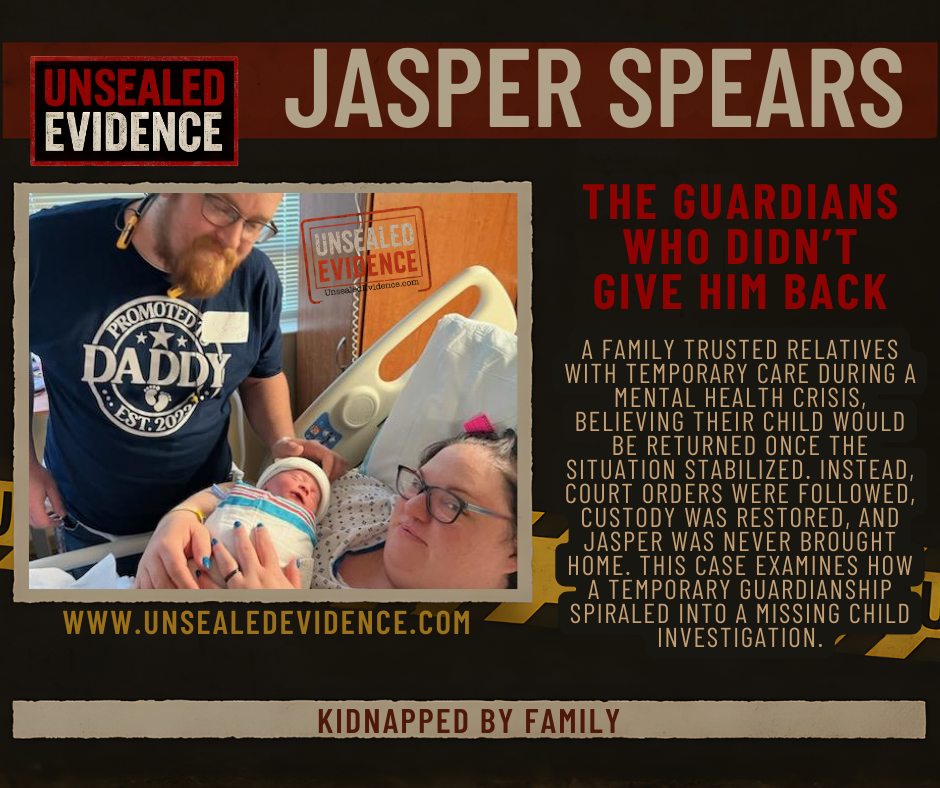
The Guardians Who Didn’t Give Him Back: Jasper Michael Spears
The Guardians Who Didn’t Give Him Back: The Disappearance of Jasper Michael Spears The Hospital Visit That Started Everything Jasper Michael Spears was born on November 6,

The Strongsville Impact: The Deaths of Dominic Russo and Davion Flanagan
In the early morning hours of July 31, 2022, a devastating crash in Strongsville left 20-year-old Dominic Russo and 19-year-old Davion Flanagan dead after a Toyota Camry driven by
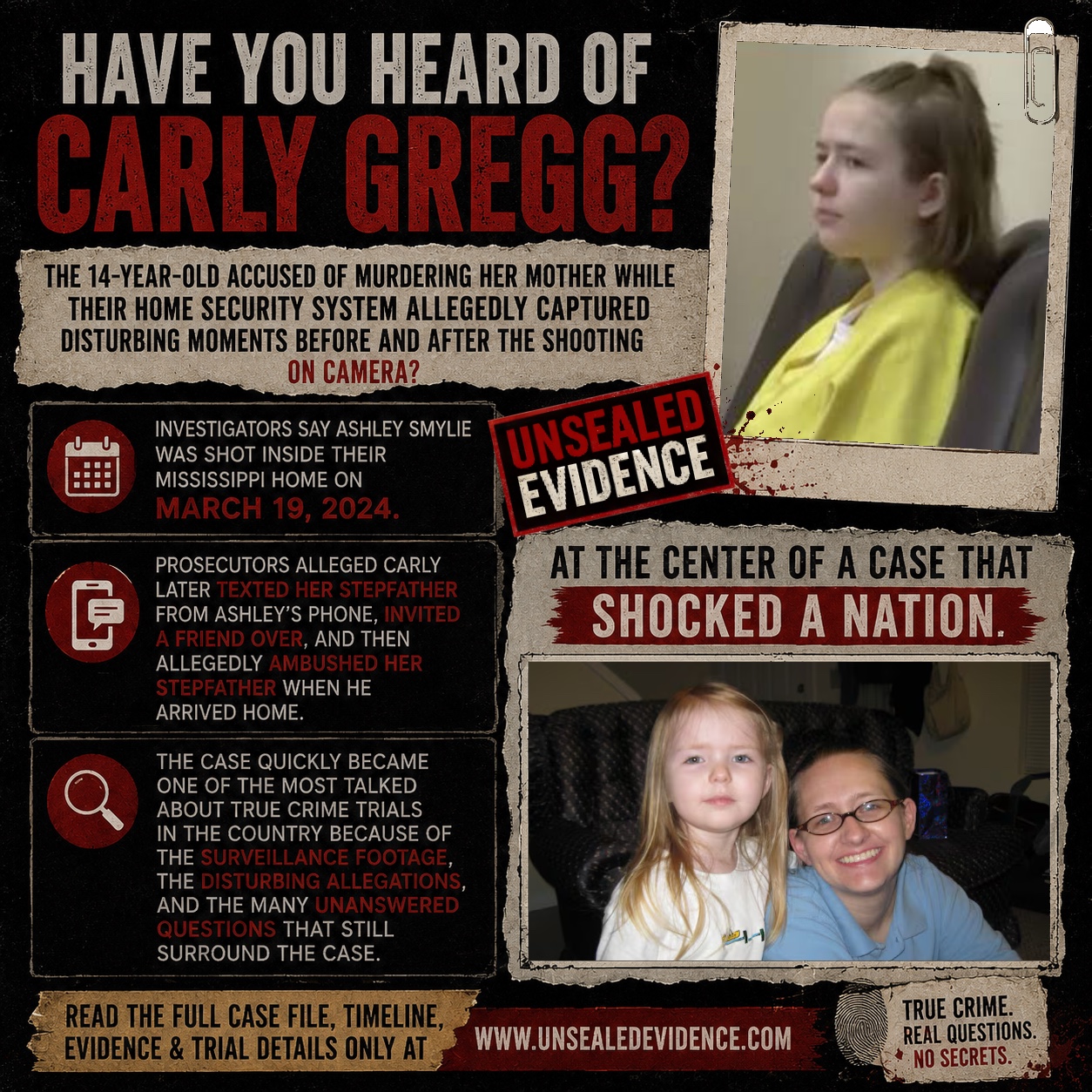
The Day the Silence Broke: A Human Account of the Carly Gregg Tragedy
March 19, 2024. A Tuesday. In the quiet, unassuming town of Brandon, Mississippi, a day that began with the mundane rhythm of school and work would spiral into a vortex of horror,
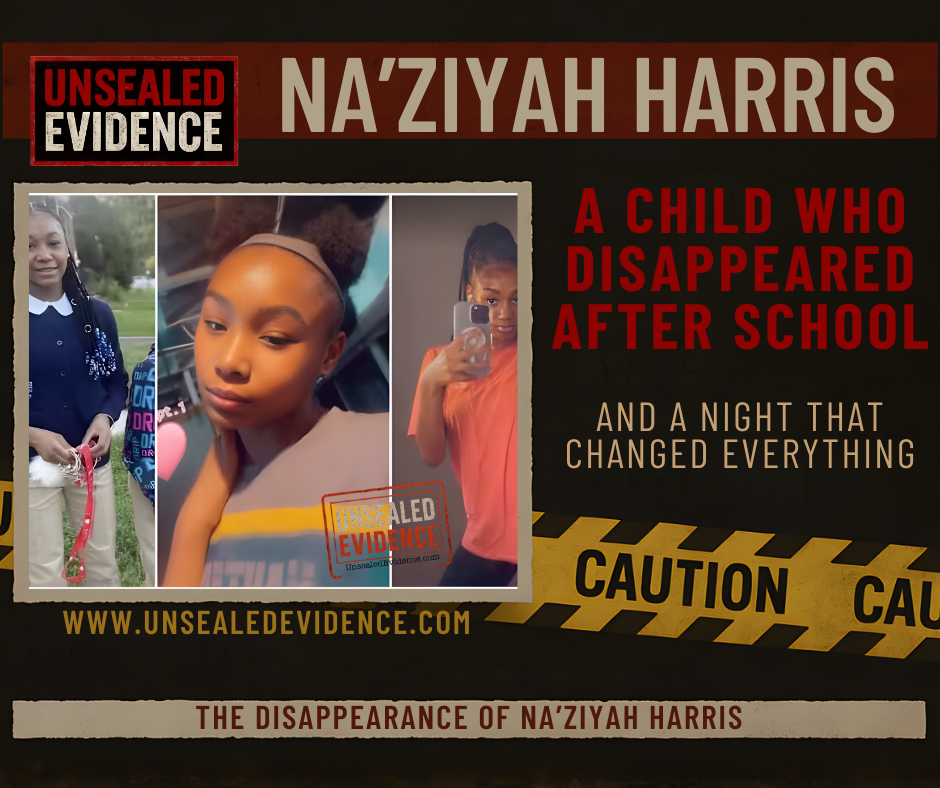
The Rugrats Coat Disappearance: The Killing of Na’Ziyah Harris Without a Body
Vanished After the Bus Stop: A Detroit Afternoon That Changed Everything On January 9, 2024, a thirteen-year-old girl stepped off her school bus on Detroit’s east side, wear
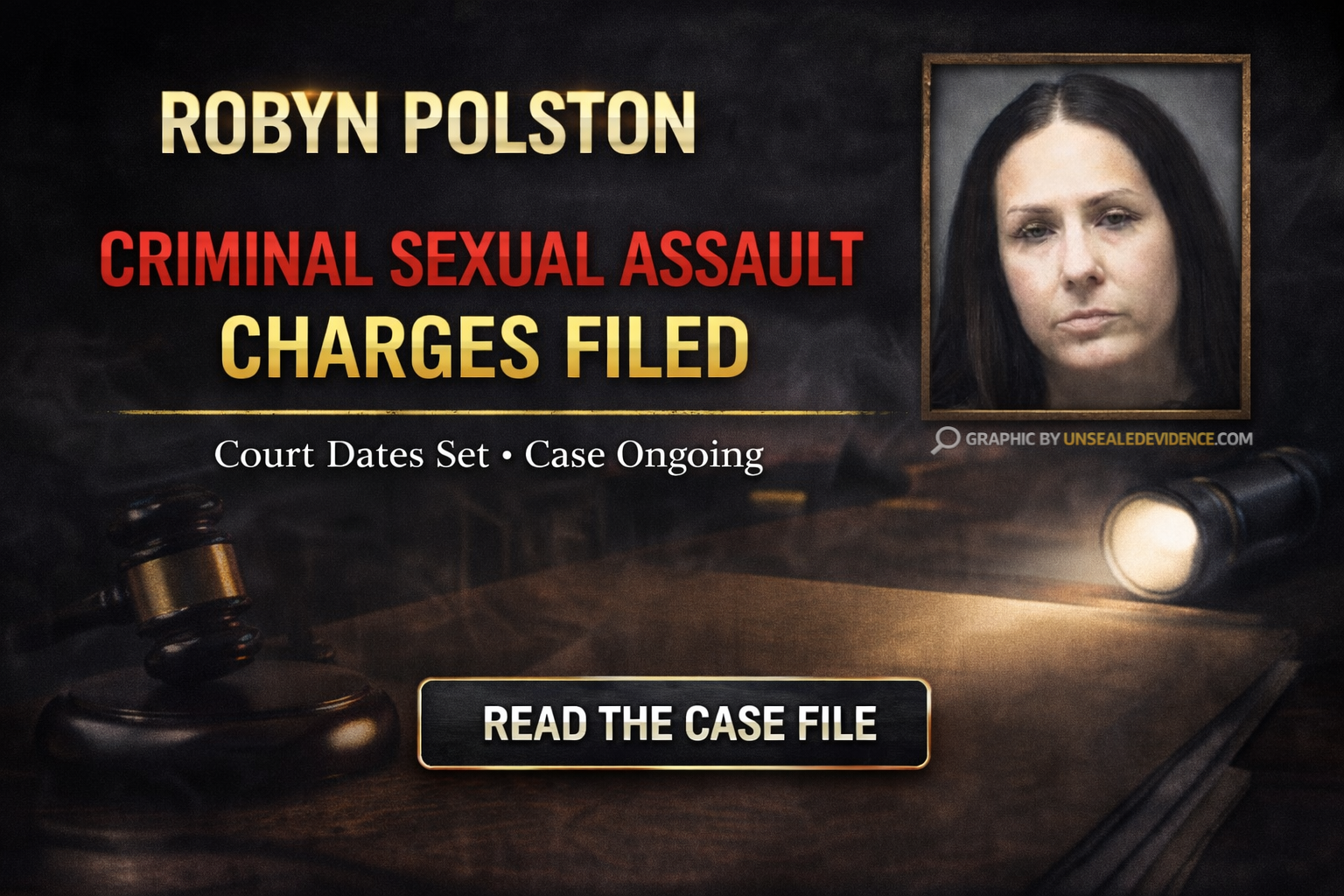
Dance Floor Deception: The Washington, Illinois Case of Robyn Polston and the Newborn at the Center of It All
The Night It Began at a School Dance In May 2023, inside a junior high school gymnasium in Washington, Illinois, colored lights reflected off polished floors as students gathered

Taken at Sears: The Abduction That Changed America Forever
Forensic and Socio-Legislative Analysis of the Adam Walsh Abduction and Its Impact on American Jurisprudence The abduction and murder of six-year-old Adam Walsh on Jul