
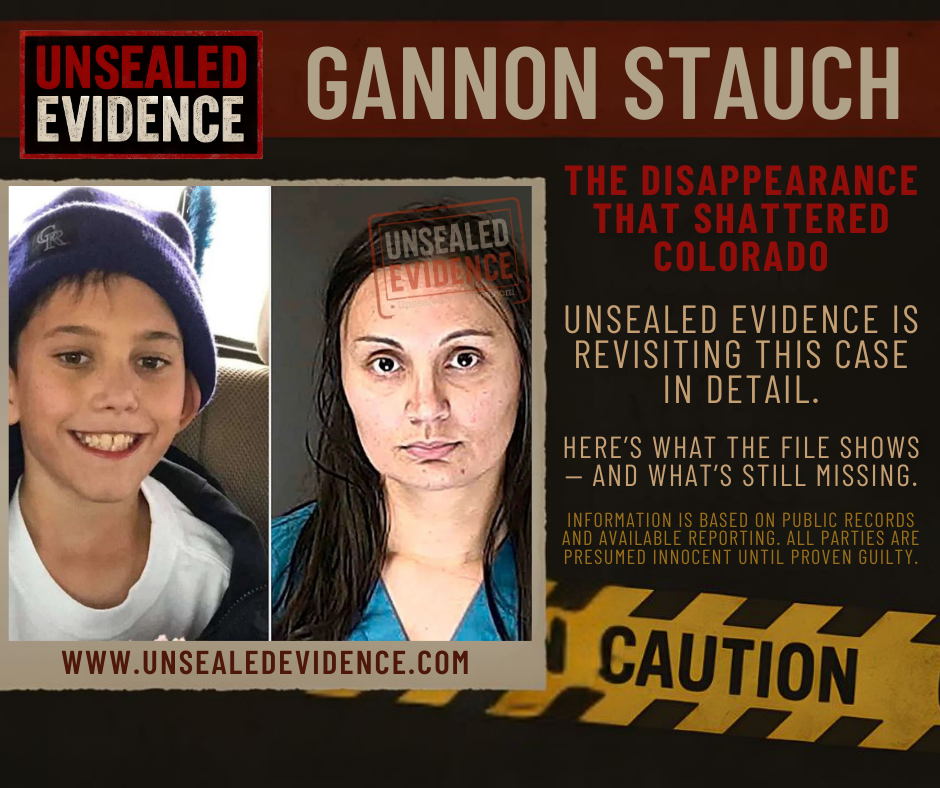
THE BOY WHO NEVER GOT TO GROW UP
There are some cases that change something inside you the moment you learn their details—cases that rearrange the air in your lungs, cases that sit heavy in your chest long after you stop reading, cases where you find yourself staring at a child’s photograph and thinking, this should not be the way the world remembers him.
The story of eleven-year-old Gannon Jacob Stauch is one of those cases.
Before the world knew his name, before search teams combed through frozen fields and detectives pieced together a nightmare hidden behind the walls of a suburban home, Gannon was just a kid. A sweet, anxious, tender-hearted boy who wanted routine more than adventure and reassurance more than independence. He had big brown eyes that looked like they were still learning how to trust the world, the soft-rounded shoulders of a child who hadn’t grown into himself yet, and a shy smile that came out only when he felt comfortable—when he felt safe.
He was the kind of child who required gentleness, and the kind of child who returned it tenfold.
But on January 27, 2020, that gentleness vanished behind a closed door, and the world would soon learn that the place where Gannon should have been safest was the place he had the most to fear.
A CHILD CAUGHT BETWEEN TWO WORLDS
To understand the weight of this case, you have to understand who Gannon was before the headlines. He lived a life stretched between two families—his biological mother, Landen, who lived out of state but adored him fiercely, and his father, Albert, who built a blended family in Colorado with his new wife, Letecia. It was a complicated family structure, but at the center of it was a little boy who just wanted to feel loved in every direction he turned.
Gannon struggled with anxiety. He had moments where the world felt too loud, too heavy, too unpredictable. But he was also gentle. Funny in a quiet way. Loving in the small, important ways children show their care. He liked video games. He liked the comfort of routine. He liked knowing that the adults around him were steady, predictable, and safe.
Those who knew him described him as a sweetheart. Sensitive. Easily startled. Quick to apologize even when he had done nothing wrong. A child who clung to reassurance because reassurance was the anchor that kept his world from spinning.
The tragedy of his story begins with this simple truth:
Gannon was a child who needed protection.
Instead, the adult responsible for him became the source of his greatest danger.
THE HOUSE THAT LOOKED LIKE EVERY OTHER HOUSE
The Stauch home in Lorson Ranch looked like any other suburban home. Snow on the front lawn. Cars in the driveway. Holiday decorations still lingering from winter. The kind of place where neighbors wave, kids ride scooters, and families leave porch lights on a little longer than necessary.
From the outside, nothing looked wrong.
Nothing looked fractured.
Nothing looked dangerous.
But homes do not reveal their secrets from the street.
Inside that house, in the weeks leading up to Gannon’s disappearance, tension simmered in ways no one fully recognized until it was too late. After the case broke, social media became a storm of unconfirmed rumors—people claiming they’d sensed something off in Letecia’s behavior, people who said she seemed overwhelmed or resentful, people who believed she struggled with the emotional needs of the children. None of those claims were proven. But they painted an emotional landscape where hindsight made people whisper, We should have known.
The truth is, no one did know.
No one imagined violence.
No one imagined betrayal on this scale.
And so, on the morning of January 27, 2020, the people who loved Gannon believed he was safe inside that house.
He wasn’t.
THE DAY THAT TOOK EVERYTHING
January 27 began with the quiet routines of winter. Kids bundled up for school, breath visible in the cold air. Traffic hummed down the road. Parents moved through their morning schedules without thinking twice. It was a day that should have been forgettable, the kind of day that passes without consequence.
But by evening, the world had changed.
According to Letecia, Gannon wasn’t feeling well that morning. She said she kept him home from school while the other children went on without him. She said she took him out later in the day—running errands, going for a drive. Surveillance footage from a neighbor’s security camera would later cast a dark shadow over those claims: it captured the family SUV backing out of the driveway, with Gannon climbing inside beside her.
Hours later, the vehicle returned.
But only Letecia stepped out of it.
That moment—silent, grainy, overlooked at first—would become a devastating centerpiece of the investigation.
Later that evening, Letecia reported Gannon missing. She said he had gone to play at a friend’s house and never returned. But even in those early hours, her story shifted. First, she said he walked to a friend’s home. Then she said she didn’t know where he went. Then she suggested he ran away.
People listened, but something in her tone felt… wrong.
Parents know what real terror sounds like.
They know the frantic pitch of a mother searching for her child.
They know the breathless panic of not knowing where a child is in the dark.
Letecia didn’t sound like that.
She sounded annoyed. Defensive. Evasive.
As if the missing child was an inconvenience instead of a crisis.
But still—investigators searched. Volunteers searched. The community held onto hope with trembling hands.
No one wanted to believe what would come next.
A MOTHER’S FEAR MADE FLESH
When Gannon’s biological mother arrived in Colorado, her grief shook the air around her. She appeared in news conferences with her face swollen from crying, her voice fractured, clutching tissues with the kind of desperation that makes strangers weep for her.
She wasn’t guarded. She wasn’t rehearsed.
She was a mother whose child was missing.
Every parent watching her recognized the rawness in her movements, the horror in her eyes, the way her sentences broke apart under the weight of fear. You could feel the ache rolling off her like waves. It was impossible not to imagine your own child in Gannon’s place, impossible not to grieve a little even if you’d never met him.
And behind her, Letecia stood with crossed arms and thin explanations, weaving story after story, each one contradicting the last.
A storm was coming, and deep down, people sensed it.
THE SEARCH THAT BECAME A WARNING
As days passed, search teams spread across miles of cold, unforgiving terrain. They checked ditches and ravines. They walked through brush so thick it cut their legs. They knocked on doors and checked abandoned structures. The community threw itself into the search with everything it had because searching meant hope. Searching meant believing he was still alive.
But hope lives on borrowed time.
Behind closed doors, investigators were already seeing things that made their stomachs twist: inconsistencies in Letecia’s statements, gaps in the timeline, movements that didn't fit her explanation. Her story was like a quilt stitched with thread that kept snapping.
At the same time, online communities exploded with theories—some compassionate, others vicious, many purely speculative. People posted screenshots, photos, long analyses of Letecia’s behavior. Some swore she had always seemed “off.” Others claimed they had seen red flags long before. These were unconfirmed opinions, but they captured something important: the collective gut feeling that something was terribly wrong.
And then investigators stepped inside the house.
Everything changed.
THE HOUSE BEGINS TO SPEAK
Every crime scene has a voice if you know how to listen.
This house did not whisper.
It screamed.
When forensic teams entered Gannon’s home, they found scenes that made their blood run cold. There were stains where stains should not be. Patterns that suggested a struggle, not an accident. Evidence of attempts to clean and hide damage. Traces of violence that no loving guardian could explain away—certainly not with the calm or confidence Letecia displayed.
The deeper the investigation went, the darker the picture became:
• Blood traces extending beyond Gannon’s room
• Signs of a significant injury
• Indicators his small body had been moved
• Cleaning agents found where no cleaning should have been needed
The home felt heavy, as if every object inside carried a memory it didn’t want to hold.
And then detectives turned to the digital evidence—search histories, messages, routes traveled, car data. Those pieces began to fit together like puzzle fragments forming a horror no one was ready to face.
Gannon hadn’t simply vanished.
He hadn’t run away.
He hadn’t wandered off.
What happened to him happened inside that house.
And the person who reported him missing was the person investigators believed had harmed him.
THE LIES THAT CRACKED UNDER THEIR OWN WEIGHT
As investigators connected the dots, Letecia’s stories grew more frantic, more chaotic, more unbelievable. She accused strangers, she invented scenarios, she painted herself as the victim. Every interview felt like watching someone drown in their own fabrication.
But lies have a short lifespan when the truth is aggressively alive.
Investigators weren’t relying on her words.
They were building a case from what she couldn’t hide.
And what she couldn’t hide was damning.
WHEN THE TRUTH BEGAN TO SURFACE
While Letecia continued twisting her story into knots, investigators were quietly assembling a reality she could no longer outrun. They analyzed vehicle data that showed miles driven in patterns that didn’t match her timeline. They mapped her movements—strange detours, unexplained stops, hours unaccounted for. They reviewed her phone data, noticing gaps, deletions, attempts to rearrange the narrative she was building around herself.
And beneath all of her frantic explanations was something far more chilling:
the evidence told the same story no matter how many times she tried to rewrite it.
Behind the walls of that home, something violent happened to Gannon.
Something irreversible.
Something Letecia could not undo, no matter how many alibis she tried to stitch together.
At the same time, the public was drowning in speculation. Social media filled with unconfirmed posts claiming she had a temper, that she seemed jealous of Gannon’s bond with his mother, that she had once spoken of the children with a coldness that made people uneasy. None of these accounts were ever verified, but they added to the emotional storm brewing online—a collective sense that this disappearance was not what it seemed, and that the truth would be far worse than anyone wanted to accept.
Inside the sheriff’s office, investigators were already preparing for the worst. They weren’t searching for a lost child anymore. They were searching for remains.
And on some level, they already knew where this case was heading.
THE ROAD NO CHILD SHOULD HAVE BEEN TAKEN DOWN
One of the heaviest pieces of evidence wasn’t found inside the house, but in the movement of the family SUV. Suburban vehicles rarely become silent witnesses to violence, but this one had no choice. Its mileage. Its GPS mapping. Its recorded trips. Every detail painted the outline of a journey Gannon never should have taken.
Hours after the violence occurred in the house, Letecia drove away with something heavy placed inside the vehicle. Investigators later determined this was likely when Gannon’s body was removed from the home. The car moved through remote areas—quiet stretches of land where no one would notice if something devastating was happening just out of sight.
You can imagine the silence in that vehicle.
The coldness.
The way a crime takes on a shape when it’s confined in a moving space.
What Letecia didn’t realize was that modern vehicles leave behind a digital breadcrumb trail. Each mile, each stop, each strange detour became part of the truth she couldn’t erase. And with every new detail uncovered, the image of what happened to Gannon sharpened into a devastating clarity.
She didn’t panic and leave him somewhere near home.
She didn’t bury him in a place of momentary fear.
She drove him across multiple states before leaving him far away from everything that ever made him feel safe.
THE DISCOVERY THAT BROKE AN ENTIRE NATION
For weeks, people held their breath. They hoped for a miracle even when the evidence suggested there wouldn’t be one. Search teams continued combing through miles of terrain in Colorado, refusing to give up. Mothers and fathers stayed up at night with shaky hands, making posts begging for updates. Children in his neighborhood kept asking their parents if Gannon was coming home soon.
Then, on March 17, 2020, everything shattered.
A suitcase was found beneath a bridge in Florida. Inside it were the remains of a small child.
When the confirmation came that it was Gannon, a wave of grief spread across the country.
It wasn’t just sadness.
It was heartbreak infused with outrage.
Because a little boy had been taken from his home…
hurt in ways no child should ever endure…
and then hidden hundreds of miles away like he was something to dispose of instead of a human being with a name, a future, a family desperate to hold him again.
His mother’s grief became the grief of everyone watching.
His father’s devastation echoed into the lives of strangers who had never met him but felt a connection to him through their screens.
And the world finally understood the truth investigators had pieced together long before:
Gannon didn’t disappear.
He was taken.
He was hurt.
He was transported.
He was hidden.
And the person responsible was the same woman who had looked into cameras and insisted she didn’t know what happened to him.
THE ARREST THAT CAME TOO LATE
Letecia was arrested in early March, before Gannon’s remains were discovered, but the news of where—and how—he had been found only solidified the case against her. Her capture was dramatic in ways it never needed to be. She resisted. She protested. She argued with officers. And during transport, she attempted to escape—not because she thought she was innocent, but because she seemed to believe she could outrun consequences forever.
Her behavior only reinforced the growing public perception that she wasn’t a panicked stepmother caught in a misunderstanding. She was someone trying to stay ahead of the truth.
And the truth was closing in.
WHAT INVESTIGATORS PIECED TOGETHER
It took countless hours, multiple agencies, and experts from several fields to reconstruct the timeline of Gannon’s final day, but the conclusion was devastating beyond words.
They believed Gannon was violently attacked inside his bedroom.
They found evidence of trauma that was severe and extensive.
They found blood in patterns consistent with injury, not with accident.
They found attempts to clean the scene, attempts that ultimately failed.
They found indicators that the assault spanned more than one space in the home.
They found that the garage and vehicle held their own pieces of the story—pieces that pointed to a child being moved after he had already been fatally injured.
There is something uniquely horrifying about children who die in their own bedrooms.
A bedroom is supposed to be a sanctuary, a safe place, the softest corner of a child’s world.
For Gannon, it became the site of betrayal.
The evidence that followed—travel logs, digital data, disposal sites—told of a cover-up both calculated and desperate. It showed a woman scraping together any excuse she could find, layering lie upon lie, trying to build a version of events where she was not the villain, even though the evidence painted her as the only person who could have harmed him.
Investigators did not need confessions or perfect clarity.
They had enough truth to fill the void Letecia tried to create with her ever-changing stories.
And that truth pointed directly to her.
THE TRIAL THAT FORCED THE WORLD TO LISTEN
When the case finally reached trial, the courtroom became a place where unimaginable violence had to be spoken out loud. Prosecutors walked the jury through the evidence with precision and gravity, step by painful step, forcing jurors to confront what Gannon endured and what was done to him after.
Letecia attempted an insanity defense, a final strategy that felt more like another attempt to dodge responsibility than an authentic explanation. She claimed she didn’t know what she was doing. That she wasn’t aware. That mental illness had consumed her.
But the evidence told a different story—one of intentional actions, calculated deceptions, and decisions made after careful thought. Her conduct after the murder, her efforts to hide the body, her manipulation of the public, her attempts to escape custody… none of it aligned with the chaos of a mind lost in illness. Instead, it echoed the behavior of someone who knew exactly what she had done and was willing to lie to the ends of the earth to avoid consequences.
The jury saw through it.
They listened.
They watched.
They studied her.
And in the end, they believed the evidence—not the stories she spun.
The verdict: guilty on all counts.
The sentence: life without parole.
Justice, at least in the legal sense, was served.
But no sentence will ever be enough—not when the victim is a child whose life had barely begun.
A FAMILY LEFT WITH EMPTY SPACE WHERE A CHILD SHOULD BE
After the trial, Gannon’s mother spoke about her son with a tenderness that made the courtroom tremble. She described his sweetness, his sensitivity, the way he curled into her arms like he was still small enough to belong there. His father kept his composure as best he could, but grief lived in his posture, in his silence, in the exhaustion of a man who lost not only his child but the trust he had placed in the person responsible for caring for him.
Siblings learned what loss feels like far too early.
A family learned how violence can ripple through generations.
And a community learned how deep its capacity for heartbreak truly is.
THE PEOPLE WHOSE LIVES WERE SHATTERED BY THIS CRIME
• Landen Hyatt — Gannon’s biological mother
• Albert Stauch — Gannon’s biological father
• Laina Stauch — Gannon’s younger sister
• Harley Hunt — Letecia’s daughter; Gannon’s stepsister
• Letecia Stauch — Stepmother; primary caregiver at time of disappearance
• Gannon’s extended family — grandparents, aunts, uncles on both sides
• The Colorado Springs community — neighbors, volunteers, search teams
• Investigators and prosecutors — individuals who worked the case to completion
THE WEIGHT OF A CHILD’S STORY
Cases like this follow you.
They stay in your chest long after the details fade.
Because this wasn’t a teenager living dangerously.
This wasn’t a missing adult with unanswered questions in their past.
This was a little boy — sensitive, anxious, gentle — who trusted the wrong person.
A little boy who should still be here.
A little boy who deserved protection, comfort, patience, and love.
When you peel back every layer of this story — every lie, every mile driven, every courtroom moment — what you’re left with is the life that was stolen.
A child who never got to grow up.
A family forever changed.
A community that still lights candles for a boy they didn’t know but wish they could have saved.
Justice can punish the guilty.
But it cannot undo the empty space where a child once stood.
It cannot restore what was lost.
It cannot heal every wound.
But what it can do — what Unsealed Evidence does — is make sure his story is told with the weight it deserves.
Gannon mattered.
He matters still.
And as long as his name is spoken, as long as the truth of what happened is unsealed and shared, he will not fade into another statistic.
This world failed him.
But his story will not be forgotten.
🕯️ Learn More • Reflect • Remember
If this case stayed with you, these resources may help you understand the investigation, process the impact, or honor the victim.
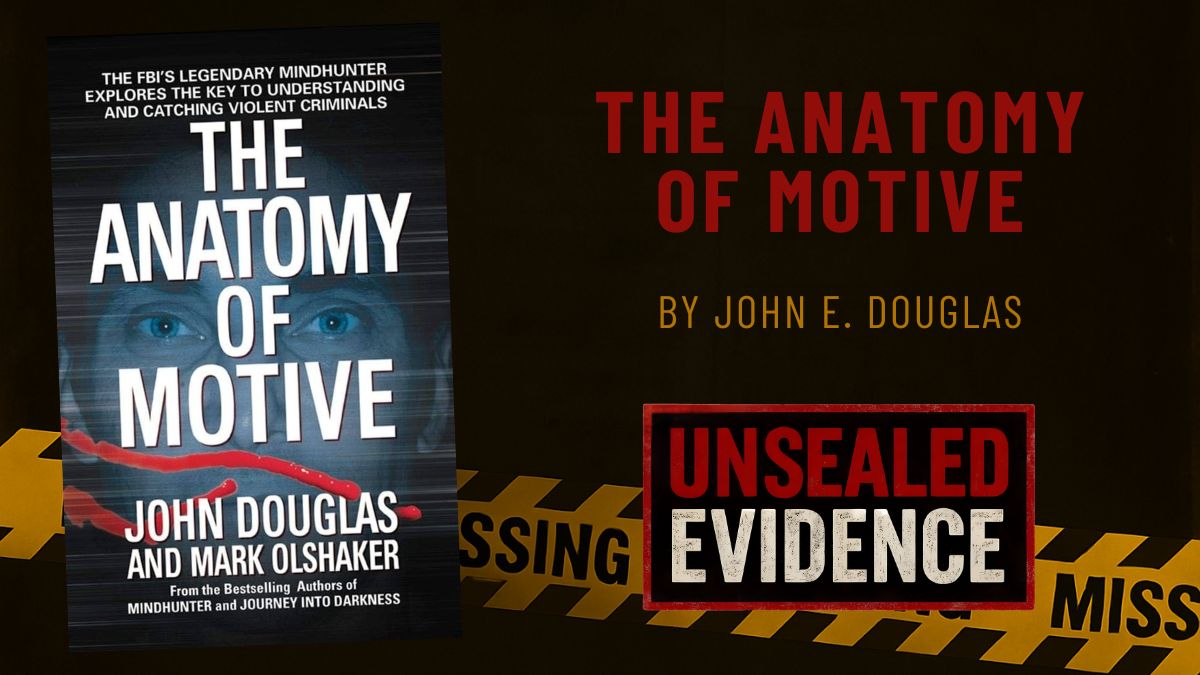
If you want a deeper understanding of how investigators interpret behavior, intent, and patterns, this book is a powerful companion to cases like Gannon’s. It’s not “true crime entertainment” — it’s insight into how the truth gets uncovered when stories don’t match the evidence.
👉 View on Amazon
One of the hardest realities in true crime is that danger doesn’t always come from strangers. This series explores cases where violence came from inside the home — and it helps put the emotional “how could this happen?” into devastating context.
👉 Watch on Amazon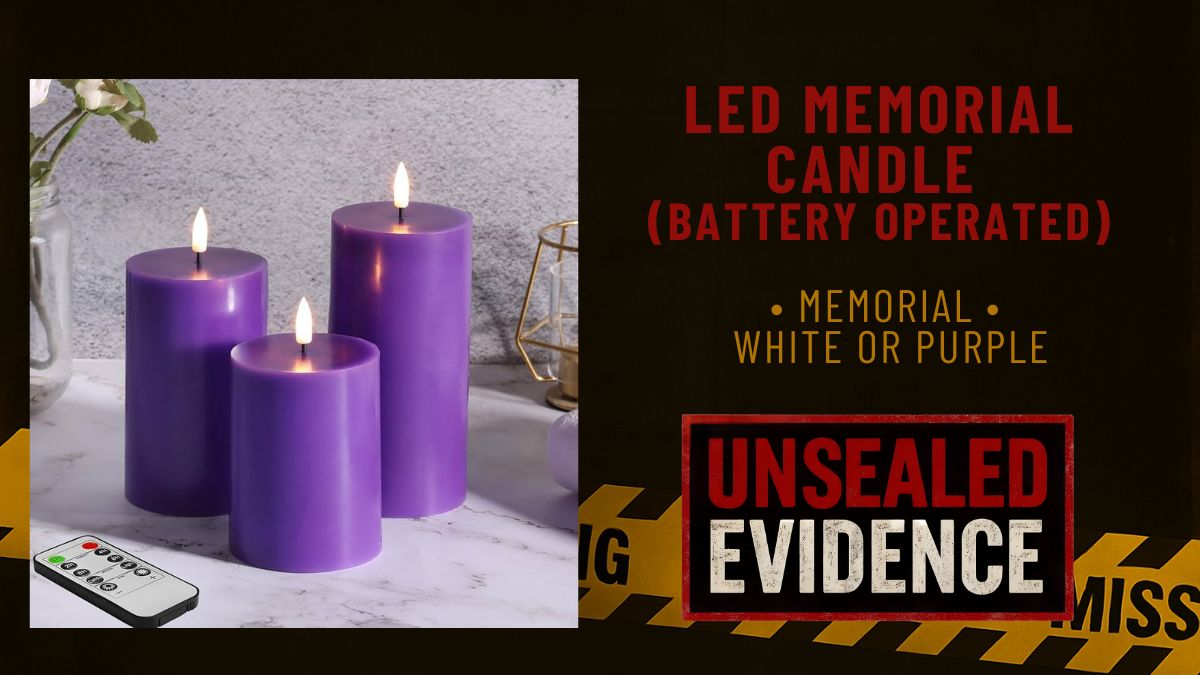
After a case like this, a lot of people don’t want to just scroll away — they want to pause and honor the life that was taken. An LED candle is a simple, safe way to hold space for remembrance. For Gannon. For every child who deserved better.
👉 View on AmazonDisclosure: Some links may be affiliate links. If you purchase through them, Unsealed Evidence may earn a small commission at no extra cost to you.
Continue Investigating

Christmas Eve Vanishing: The Camila Mendoza Olmos Story
Christmas Eve Vanishing: The Camila Mendoza Olmos Story Camila Mendoza Olmos, a 19-year-old college student in northwest Bexar County, Texas, disappeared on the morning of Wednesd

Behind the Locked Door: The Ty and Bryn Larson Custody Battle and the 54-Day Barricade
The Ty and Bryn Larson case became one of the most controversial and widely discussed family court stories in recent years after two Utah siblings barricaded themselves inside an u
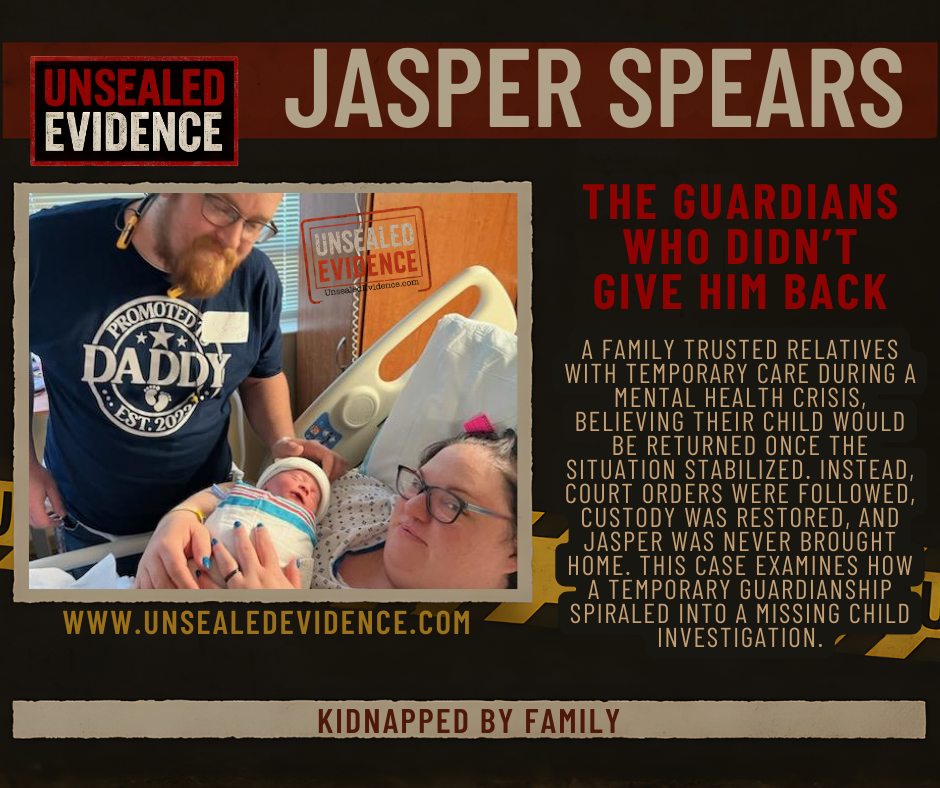
The Guardians Who Didn’t Give Him Back: Jasper Michael Spears
The Guardians Who Didn’t Give Him Back: The Disappearance of Jasper Michael Spears The Hospital Visit That Started Everything Jasper Michael Spears was born on November 6,

The Strongsville Impact: The Deaths of Dominic Russo and Davion Flanagan
In the early morning hours of July 31, 2022, a devastating crash in Strongsville left 20-year-old Dominic Russo and 19-year-old Davion Flanagan dead after a Toyota Camry driven by
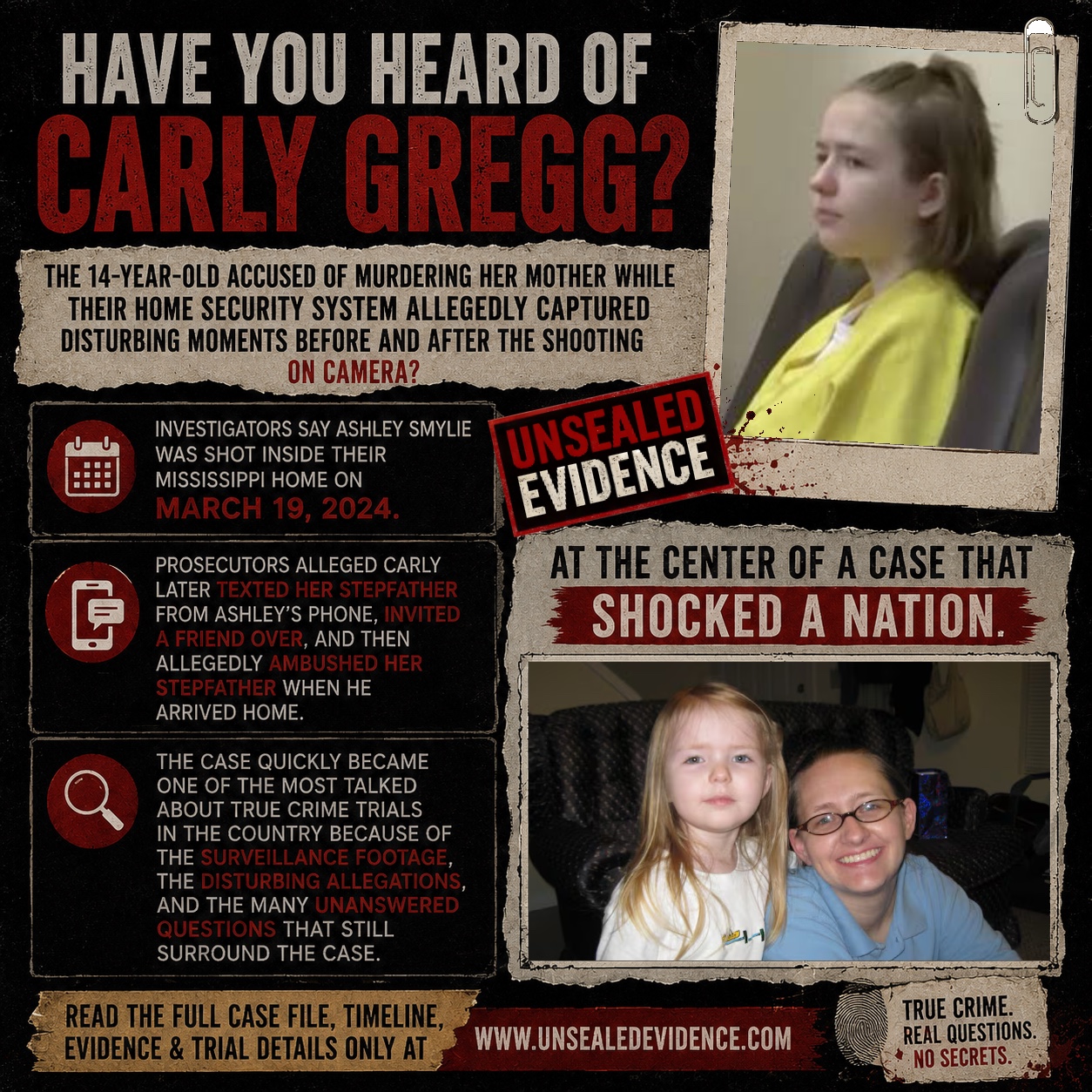
The Day the Silence Broke: A Human Account of the Carly Gregg Tragedy
March 19, 2024. A Tuesday. In the quiet, unassuming town of Brandon, Mississippi, a day that began with the mundane rhythm of school and work would spiral into a vortex of horror,
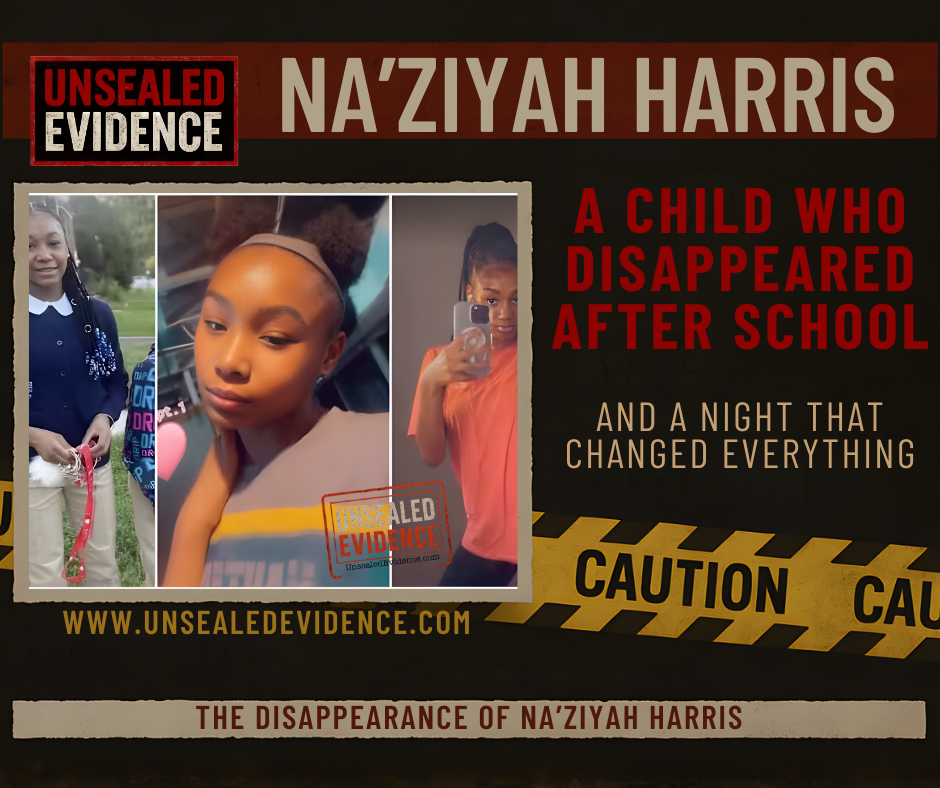
The Rugrats Coat Disappearance: The Killing of Na’Ziyah Harris Without a Body
Vanished After the Bus Stop: A Detroit Afternoon That Changed Everything On January 9, 2024, a thirteen-year-old girl stepped off her school bus on Detroit’s east side, wear
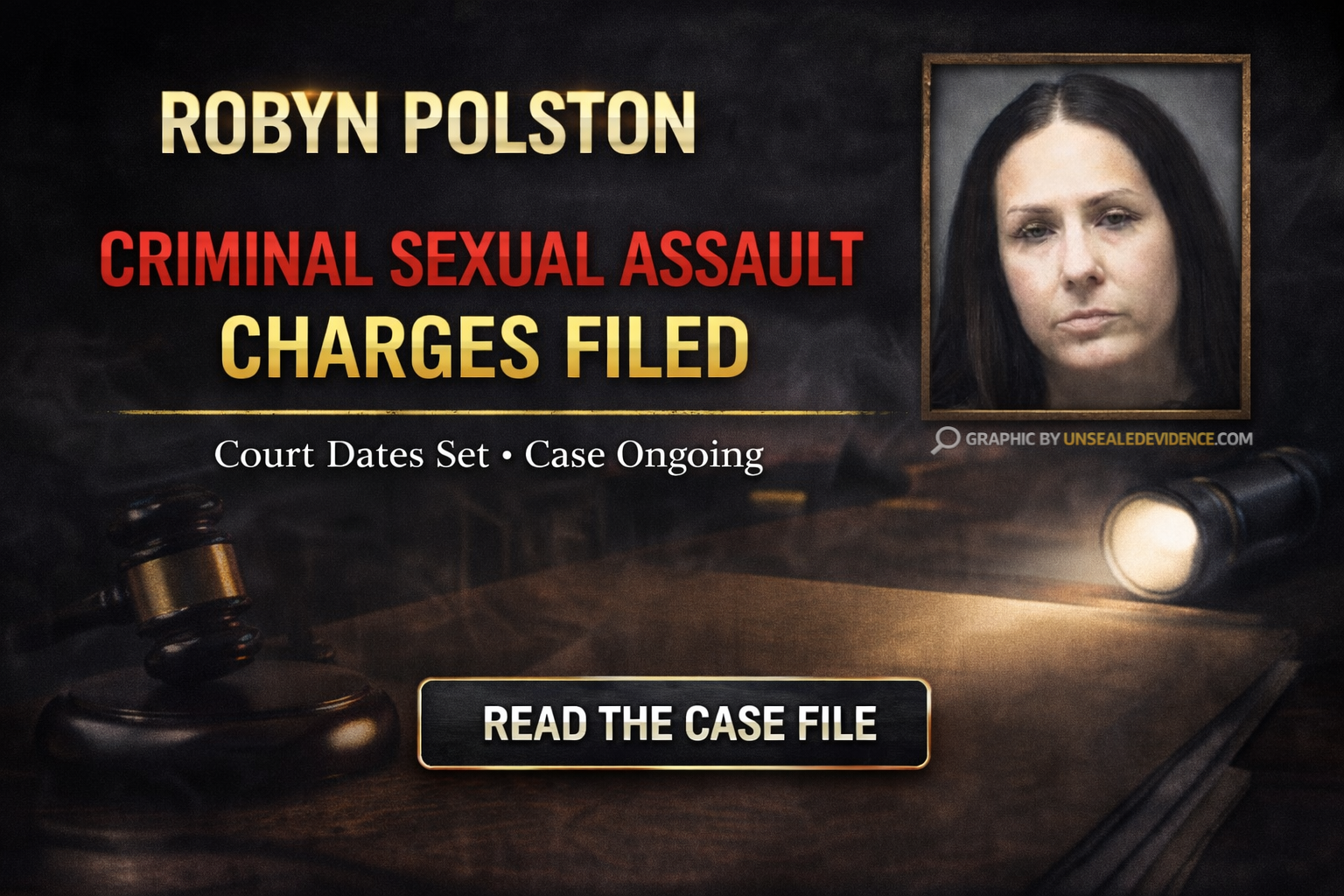
Dance Floor Deception: The Washington, Illinois Case of Robyn Polston and the Newborn at the Center of It All
The Night It Began at a School Dance In May 2023, inside a junior high school gymnasium in Washington, Illinois, colored lights reflected off polished floors as students gathered

Taken at Sears: The Abduction That Changed America Forever
Forensic and Socio-Legislative Analysis of the Adam Walsh Abduction and Its Impact on American Jurisprudence The abduction and murder of six-year-old Adam Walsh on Jul