
The Vanishing of Sebastian Rogers
In the hush of a Hendersonville neighborhood on February 26, 2024, the Rogers family awoke to a nightmare. Fifteen-year-old Sebastian Wayne Drake Rogers had simply disappeared from his home. The previous day had been unremarkable: Sebastian spent the day shopping and playing video games with his mother, Katie. They shared an ordinary family dinner and returned home by nightfall. Sebastian’s mother tucked him into bed between 9 and 10 p.m. that Sunday, even checking on him after hearing a thump from his bedroom. Sebastian reassured her he was fine, and by midnight, Katie went to sleep. When dawn broke the next morning, Sebastian’s bedside was empty. His mother was stunned to find no sign of her son anywhere in the house or neighborhood. A frantic search around their street and calls to neighbors and even his nearby school yielded nothing. His father, Seth Rogers, who had been working out of state, was immediately contacted. By mid-morning, the family reported Sebastian missing to authorities, launching a frantic manhunt.
The response was overwhelming. Within hours, local law enforcement descended on the quiet subdivision around Stafford Court. Neighbors were interviewed, yards combed, and every home in the area searched. Search teams formed a circle around the Rogers house, extending nearly five miles outward. Over the first week, more than 2,000 volunteers, deputies, police officers and rescue teams scoured 44,000 acres around Hendersonville. Canoes and divers checked ponds and streams, helicopters hovered over wooded areas, and specially-trained tracking dogs combed the terrain. The Tennessee Bureau of Investigation (TBI) and the Federal Bureau of Investigation (FBI) were called in on the second day. FBI agents brought behavioral analysts to the scene, providing crucial insight: autistic children like Sebastian are often drawn to water and prone to wandering. This led searchers to drain nearby ponds and intensify searches along rivers and lakes in case Sebastian had unknowingly slipped into one. All the while, Sebastian’s mother and stepfather, Katie and Chris Proudfoot, joined the search efforts, placing fliers and talking to searchers about Sebastian’s routine and habits.
Investigators soon realized just how baffling the situation was. Sebastian had not taken anything with him – no change of clothes, no shoes, not even his tiny yellow flashlight. His cellphone and any spare cash remained on the dining room table exactly where they were left the night before. Video footage from security cameras and a dashcam in Katie’s car confirmed that after Sebastian was tucked into bed, no one entered or left the house that night. No unknown vehicles were spotted in the driveway. It was as if Sebastian vanished into thin air. Detectives noted that without his phone or wallet, he could not have left the neighborhood on his own — which sent investigators scrambling for answers. Sheriff Eric Craddock of Sumner County emphasized that everyone should keep an open mind, but the immediate concern was Sebastian’s safety as a vulnerable 15-year-old boy with autism.
Rumors and theories swirled in the absence of facts. A video from the parking lot of the local restaurant where Sebastian and his mother had dined showed a stranger in a green hoodie briefly speaking with them. Internet sleuths fixated on this, but law enforcement soon identified the man as a regular customer who had been cleared as an innocent passerby. Another wild theory centered on a late-night security video from a nearby home. Two flickering lights in the footage looked like flashlights in Sebastian’s yard, suggesting someone might have been lurking outside. Investigators painstakingly mapped the camera angles and even overlaid daylight imagery of the neighborhood. They discovered the lights were not secret flashlights at all but the headlights of a truck some 300 yards away on a hill. Officials urged the community to ignore unverified social media posts and instead focus on confirmed information. The Sumner County Sheriff’s Office even issued a warning after a photo circulated online claiming it showed Sebastian; officials quickly debunked it, confirming the boy in the image was not him. With each rumor dispelled, the focus remained on finding Sebastian alive and well.
Portrait of Sebastian
Sebastian Rogers was more than a missing case number; he was a young boy full of curiosity and warmth. At home he loved being read bedtime stories and sharing popcorn during movie nights. He attended a school for children with autism where he was described as polite and kind, often helping teachers by organizing classroom books. His smiles were shy but genuine, lighting up when his favorite sci-fi character won a battle. Friends and family remember him building intricate Lego spaceships and reading about marine biology. Ironically, authorities noted he had an intense fascination with water — he loved visiting fish ponds and watching rainstorms from the porch. This made the investigators especially worried that he might seek out water after wandering. Sebastian had no known enemies, no history of running away, and had faithfully taken the bus to school every morning. He was sometimes cautious with strangers, but often greeted new neighbors with a quick “hello” and a wave. Because of his autism, Sebastian had routines that helped him feel secure. Missing this routine even for a day was completely out of character. His disappearance hit those routines – and his loved ones – like a lightning bolt of confusion and terror. Today, Sebastian would be a tall, now 16-year-old young man. He remains non-verbal in the sense that he hasn’t communicated, so those who loved him cling to the belief that he is alive out there somewhere, calling softly in their hearts, waiting to be heard.
The Search Grows
In the days that followed his disappearance, Hendersonville became ground zero for one of the largest child searches in Tennessee’s recent memory. Family, friends and strangers alike joined the hunt. Boats combed lake shores, ATVs crunched through underbrush, and specialized marine teams drained ponds filled with lily pads and mud. High above, spotter planes swept the ground, guided by search managers on the radio. Through it all, Sebastian’s family was never far from the action. Katie Proudfoot rode in search vehicles, carrying Sebastian’s photo and descriptions, speaking to every volunteer. She insisted that the smallest detail — a blue book, a candy wrapper — might break the case. The Proudfoots kept Sebastian’s bedroom door closed and turned into a sort of shrine: a plate of his last dinner still set on the kitchen table as investigators worked the home for clues. Friends organized prayer vigils and candlelight gatherings on Stafford Court, turning what was once a peaceful cul-de-sac into a constant reminder of one empty bedroom.
Pressure mounted on law enforcement to produce results. Sebastian’s father publicly appealed for the FBI to take a stronger role, calling for more hours on the case. The Sumner County Sheriff’s Office repeatedly said they were “chasing every lead” and coordinating with the FBI and TBI, but the truth was that as weeks passed, hopes began to fade. Sebastian’s case gained a wider audience when major networks and internet crime-watch sites told his story. Social media amplifiers sprang up, with hashtags like #FindSebastian and #BringSebastianHome. Every reported sighting, every rumor was dissected. A popular video game streamer even broadcasted his poster, urging viewers worldwide to keep an eye out. But the vast majority of tips led nowhere. Sebastian’s family maintains an online map where they track every reported lead — from one sighting in Florida to another in Kentucky — but so far none have been confirmed. The Proudfoots worry about the toll this is taking on Sebastian. Without his daily medication, even short lapses can cause confusion; Sebastian did not have any medication with him when he vanished. Experts warned that a missed dose of his autism medication could lead to acute distress. Every passing day without him receiving care heightens the fears for his well-being.
Through it all, law enforcement has had one consistent message: the investigation is ongoing but there is no evidence pointing to foul play yet. They have publicly confirmed the timeline inside the house: Sebastian never left on foot or by car after going to bed. If he wandered away on his own, it must have been in the cover of total darkness. To check every possibility, deputies knocked on more than 500 nearby doors and collected video from nearly every neighborhood camera. None showed Sebastian leaving. Authorities even dismantled the house to look for hidden clues; in some documented searches like this, agents would crawl under the porch or check attic spaces, but Sebastian’s bedroom held no mystery. After exhaustive searches yielded no trace, Sheriff Craddock appealed directly to the public: keep sharing Sebastian’s official missing-person flyer, and call immediately with any information, no matter how small. The FBI has publicly offered a $50,000 reward for information that leads to Sebastian. Every law enforcement statement carefully avoids speculation; instead, they emphasize facts. Investigators have not ruled out any scenario — accident, abduction, or something more benign — but they have offered no definitive theory. The community has been asked to stay vigilant, to think of any encounters with strangers who resemble Sebastian’s description. To date, all that is confirmed is that 15-year-old Sebastian left home with nothing in hand and was never seen again.
Continue Investigating

Christmas Nightmare: The Unsolved Murder of JonBenét Ramsey
Christmas Nightmare: The Unsolved Murder of JonBenét Ramsey The Morning the Ransom Note Appeared Christmas night in Boulder, Colorado ended quietly. Wrapping paper littere
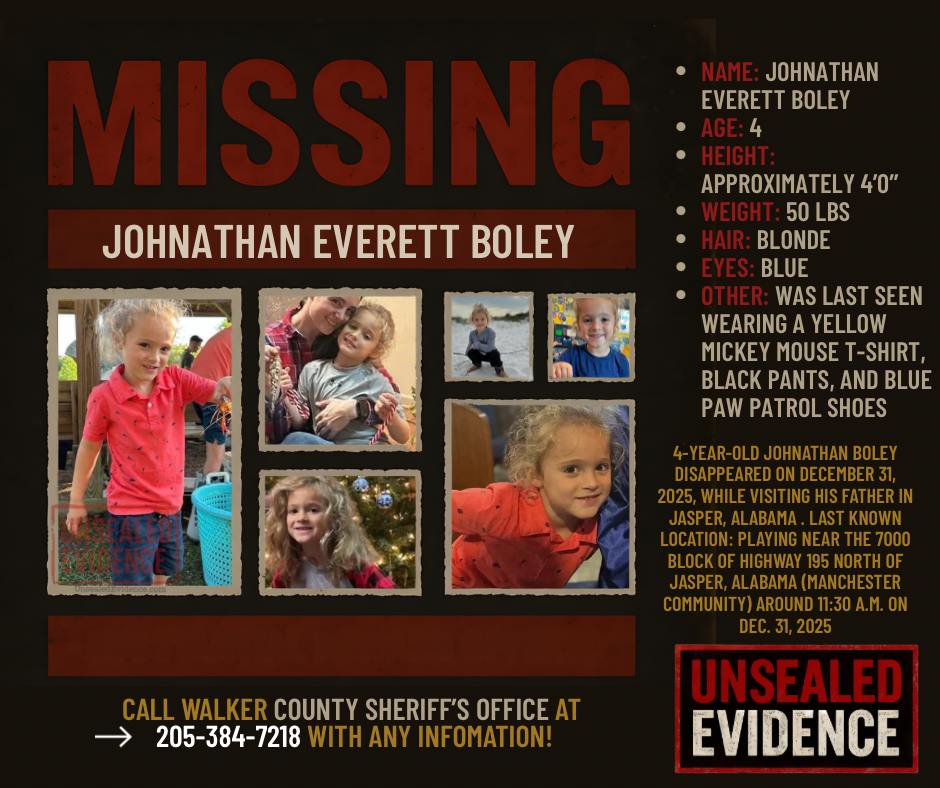
Vanished on New Year’s Eve: The Search for Johnathan Boley
Vanished on New Year’s Eve: The Search for Johnathan Boley A Holiday Visit Takes a Dark Turn The morning of December 31, 2025, began like any other festive holiday for one

Christmas Eve Vanishing: The Camila Mendoza Olmos Story
Christmas Eve Vanishing: The Camila Mendoza Olmos Story Camila Mendoza Olmos, a 19-year-old college student in northwest Bexar County, Texas, disappeared on the morning of Wednesd

Behind the Locked Door: The Ty and Bryn Larson Custody Battle and the 54-Day Barricade
The Ty and Bryn Larson case became one of the most controversial and widely discussed family court stories in recent years after two Utah siblings barricaded themselves inside an u
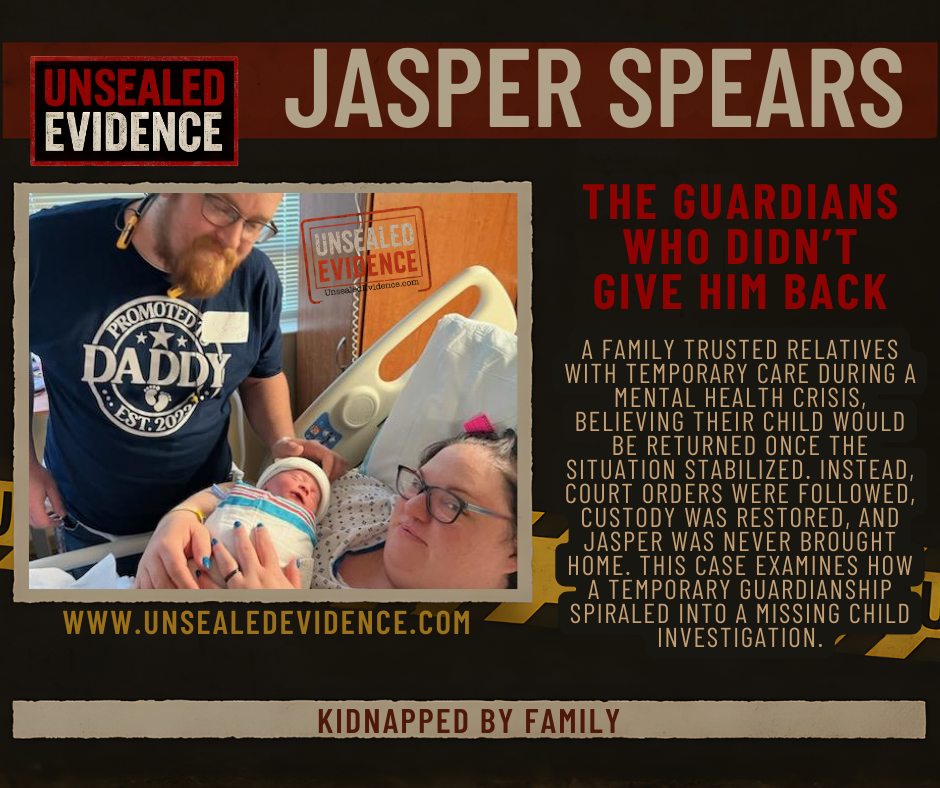
The Guardians Who Didn’t Give Him Back: Jasper Michael Spears
The Guardians Who Didn’t Give Him Back: The Disappearance of Jasper Michael Spears The Hospital Visit That Started Everything Jasper Michael Spears was born on November 6,

The Strongsville Impact: The Deaths of Dominic Russo and Davion Flanagan
In the early morning hours of July 31, 2022, a devastating crash in Strongsville left 20-year-old Dominic Russo and 19-year-old Davion Flanagan dead after a Toyota Camry driven by

The Day the Silence Broke: A Human Account of the Carly Gregg Tragedy
March 19, 2024. A Tuesday. In the quiet, unassuming town of Brandon, Mississippi, a day that began with the mundane rhythm of school and work would spiral into a vortex of horror,
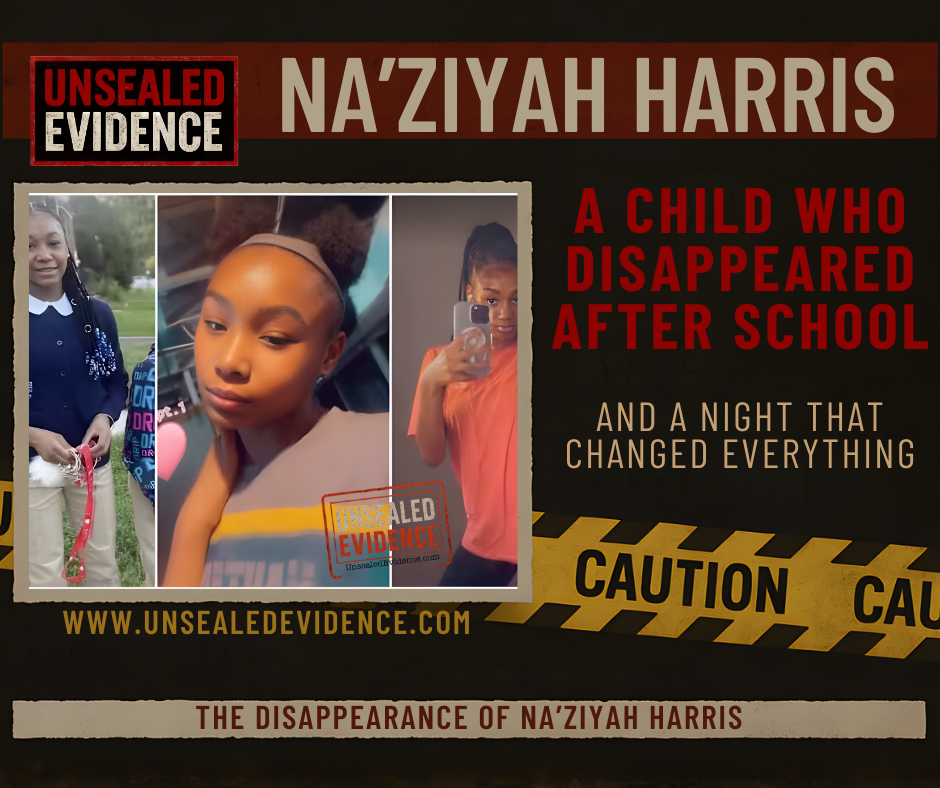
The Rugrats Coat Disappearance: The Killing of Na’Ziyah Harris Without a Body
Vanished After the Bus Stop: A Detroit Afternoon That Changed Everything On January 9, 2024, a thirteen-year-old girl stepped off her school bus on Detroit’s east side, wear