
Christmas Nightmare: The Unsolved Murder of JonBenét Ramsey
The Morning the Ransom Note Appeared
Christmas night in Boulder, Colorado ended quietly. Wrapping paper littered the floor, toys sat half-assembled, and a six-year-old girl slept in her bed after a full day of celebration. The Ramsey home looked exactly as it should have on December 25, 1996 — warm, comfortable, and safe.
By dawn, that illusion shattered.
In the early morning hours of December 26, Patsy Ramsey discovered a handwritten note placed on the staircase inside the family home. It wasn’t short. It wasn’t frantic. It wasn’t written as if time was scarce. It was long — more than two pages — deliberate in tone, and structured as instructions rather than a plea.
The note addressed “Mr. Ramsey” directly. It claimed JonBenét had been taken by a group and demanded $118,000 for her safe return. The writer warned against contacting police and gave specific directions regarding money denominations and timing. It ended with a signature — “S.B.T.C.” — a cryptic acronym that has never received an official, publicly confirmed explanation.
Patsy Ramsey called 911 at approximately 5:52 a.m., reporting her daughter missing. Despite the warning in the note, police were contacted immediately. Family friends were also called and arrived at the home to offer support, filling the house with movement, emotion, and confusion during what would later be recognized as critical investigative hours.
Officers arrived and began searching the home, initially treating the situation as a kidnapping. The house was not sealed as a controlled crime scene. People moved freely through rooms. Surfaces were touched. Items were shifted. In the chaos of fear and disbelief, potential evidence was unknowingly disturbed.
No ransom call came.
Hours passed. The note promised contact, but silence followed.
Later that day, with no word from anyone claiming responsibility for JonBenét’s disappearance, Detective Linda Arndt — reportedly the only detective still present in the home — urged John Ramsey to search the house again. John Ramsey and a family friend went into the basement. In a small, windowless storage room often referred to as a wine cellar, they found JonBenét’s body.
She was lying on the floor, covered with a white blanket. Duct tape covered her mouth. A cord was tied around her neck and attached to a crude garrote-like device. Her wrists were bound.
John Ramsey carried his daughter upstairs. It was an instinctive act — a father reacting to unimaginable loss — but it further compromised the scene. Attempts were made to remove the tape and loosen the bindings. The moment ceased to be investigative and became purely human.
An autopsy later determined JonBenét died from a combination of strangulation and blunt force trauma. She had suffered a severe skull fracture. Findings also included genital injury — a highly sensitive and debated aspect of the case that would become central to many interpretations.
The note said kidnapping. The child was never taken.
The note demanded ransom. The body was left behind.
Nothing aligned cleanly. And from that moment forward, the case would fracture — not only in evidence, but in belief.
The Child Behind the Headlines
JonBenét Patricia Ramsey was six years old.
She was born in August 1990 and grew up in a household that, by most outward measures, reflected success and stability. Her father, John Ramsey, was a businessman. Her mother, Patsy Ramsey, was deeply involved in her children’s lives and had once competed in beauty pageants herself.
JonBenét was bright, outgoing, and expressive. Family videos show her dancing, laughing, and clinging to her parents. She adored her older brother, Burke, and was known by family as affectionate and playful.
Pageants became part of her childhood early. Under her mother’s guidance, JonBenét competed in child beauty pageants throughout Colorado. The costumes, makeup, and stage presence later became a focal point of public debate, shaping perceptions of the case long before most people understood the facts. For some, the pageants raised questions about exposure and vulnerability. For others, they were simply a hobby shared between mother and daughter.
What is often lost is that JonBenét was still a child — a first grader with routines, friends, favorite foods, and a sense of safety rooted in her home.
On Christmas Day 1996, she spent the day with her family and later attended a holiday gathering. She reportedly fell asleep on the drive home and was carried inside and put to bed. That was the last confirmed time she was seen alive.
Her last known location was her own home.
Her death struck a nerve far beyond Boulder because it violated a fundamental expectation — that a child is safest in her bed, on Christmas night, surrounded by family.
The Case That Split the World in Two
From the beginning, the investigation into JonBenét Ramsey’s death was marked by division — between investigators, between theories, and between what felt emotionally believable and what could be proven.
Early criticism focused on scene management. The presence of friends in the home, the lack of strict perimeter control, and the movement of JonBenét’s body all contributed to concerns that crucial evidence may have been lost or contaminated in the first hours.
Almost immediately, two dominant theories emerged.
One centered on an intruder — someone who entered the home, wrote the ransom note, and committed the crime. Supporters of this theory point to the unidentified male DNA profile associated with JonBenét’s clothing, arguing it must be central to the case. They also cite the basement window debate, the complexity of the note, and aspects of the crime that suggest planning and control.
The other theory focused on the family — arguing the ransom note was staging and the crime occurred within the household. The length of the note, the use of materials from inside the home, and disbelief that an outsider could remain inside long enough to write multiple pages without detection fueled this view.
These theories did not just divide the public. They divided professionals.
Over time, former investigators publicly accused different members of the Ramsey family. Detective Linda Arndt later accused John Ramsey. Detective Steve Thomas later accused Patsy Ramsey, suggesting a domestic incident escalated and was covered up. These accusations were mutually exclusive — and neither resulted in charges.
In 1997 and 1998, investigative efforts intensified. Veteran homicide investigator Lou Smit became a prominent advocate of the intruder theory, emphasizing evidence he believed supported an outside offender and stressing the importance of the unidentified DNA.
A grand jury was convened in 1998 and reviewed evidence for more than a year. No public charges were filed. Years later, it was revealed that the grand jury had voted to indict John and Patsy Ramsey on charges suggesting they placed JonBenét in danger and hindered prosecution. The district attorney declined to sign the indictment, stating the evidence did not meet the standard required for prosecution.
That decision became one of the most misunderstood elements of the case — treated by some as proof of guilt, by others as proof of innocence — when in reality it reflected a legal gap between suspicion and proof beyond a reasonable doubt.
The ransom note remained one of the most analyzed documents in criminal history. Its tone, length, and specificity suggested performance rather than panic. Comparisons have been drawn to earlier historical ransom communications, including cases that demanded specific denominations and threatened consequences for contacting authorities. Similarities alone prove nothing, but they continue to fuel debate about imitation, influence, or coincidence.
Another line of discussion centers on offender behavior. Some probability-based analyses argue that crimes involving restraint and concealment increase the likelihood of glove use, which could explain limited fingerprints. These arguments are behavioral in nature — explanatory frameworks, not evidence of identity.
Over the decades, false confessions surfaced and collapsed. Private investigations proliferated. Lawsuits were filed. The Ramseys lived under relentless scrutiny, while Boulder police faced ongoing criticism for early decisions.
In recent years, official statements have emphasized that the case remains active. Investigators continue to review tips, conduct interviews and re-interviews, and revisit evidence using advancing technology. Public commentary has also claimed renewed investigative focus and “fresh eyes,” though specific details have not been formally confirmed.
Alongside official updates, more extreme claims circulate — including assertions that an arrest is imminent or that the author of the ransom note has been identified. At this time, such claims are not official and must be treated as speculation.
The tragedy of this case is not just that it remains unsolved — but that nearly every piece of evidence can be interpreted in opposite ways, leaving truth suspended between belief and proof.
The Official Record vs. the Noise
Authorities have confirmed JonBenét Ramsey’s death was ruled a homicide caused by strangulation and blunt force trauma. The autopsy documented a severe skull fracture and a ligature consistent with a garrote. Genital injury was also documented and remains a sensitive and contested element of the case.
Investigators have confirmed the ransom note was written on paper from inside the Ramsey home using a writing instrument from the home. Public handwriting analysis has remained contested and has not produced a definitive, universally accepted author.
DNA evidence associated with the case includes an unidentified male profile. The meaning and significance of that DNA remains debated publicly, but authorities have stated the case remains open and active.
In official anniversary-era messaging, Boulder police leadership has stated investigators continue to follow up on tips, conduct interviews, re-evaluate evidence, and consider technological advances that may generate new leads.
No individual has been charged.
The Questions That Won’t Go Quiet
- Who wrote the ransom note, and why was it so long and controlled in tone?
- What does “S.B.T.C.” mean, and why was that signature chosen?
- Why was the ransom set at $118,000, and what does that number truly reflect?
- If ransom was the motive, why was JonBenét never removed from the home?
- What is the true significance of the unidentified male DNA?
- Was the basement window involved in entry or exit, or is it a misleading detail?
- What does the pineapple evidence reveal about the timeline?
- What explains the marks some interpret as stun-gun related while others dispute that conclusion?
- What led the grand jury to vote for indictment, and what did they believe occurred?
- How much evidence was lost or compromised in the first hours?
- Are historical ransom similarities meaningful or coincidental?
- Will modern forensic methods finally produce answers?
Key individuals & relationships
JonBenét Ramsey - Victim - Six-year-old child found deceased in her family’s Boulder home; case remains unsolved.
Patsy Ramsey - Mother - Discovered ransom note and called 911; faced public suspicion; never convicted.
John Ramsey - Father - Found JonBenét in the basement after being urged to search; publicly advocates for continued investigation.
Burke Ramsey - Brother - Nine years old at the time; never charged; subject of public speculation.
Detective Linda Arndt - Investigator - Present during critical hours; later publicly accused John Ramsey.
Detective Steve Thomas - Investigator - Publicly accused Patsy Ramsey; resigned from department.
Lou Smit - Investigator - Strong advocate of intruder theory.
Alex Hunter - District Attorney - Declined to sign grand jury indictment.
Mary Lacy - District Attorney - Later oversight; publicly stated family was cleared in relation to certain DNA interpretations.
Stephen Redfearn - Police Leadership - Emphasized continued active investigation.
Continue Investigating
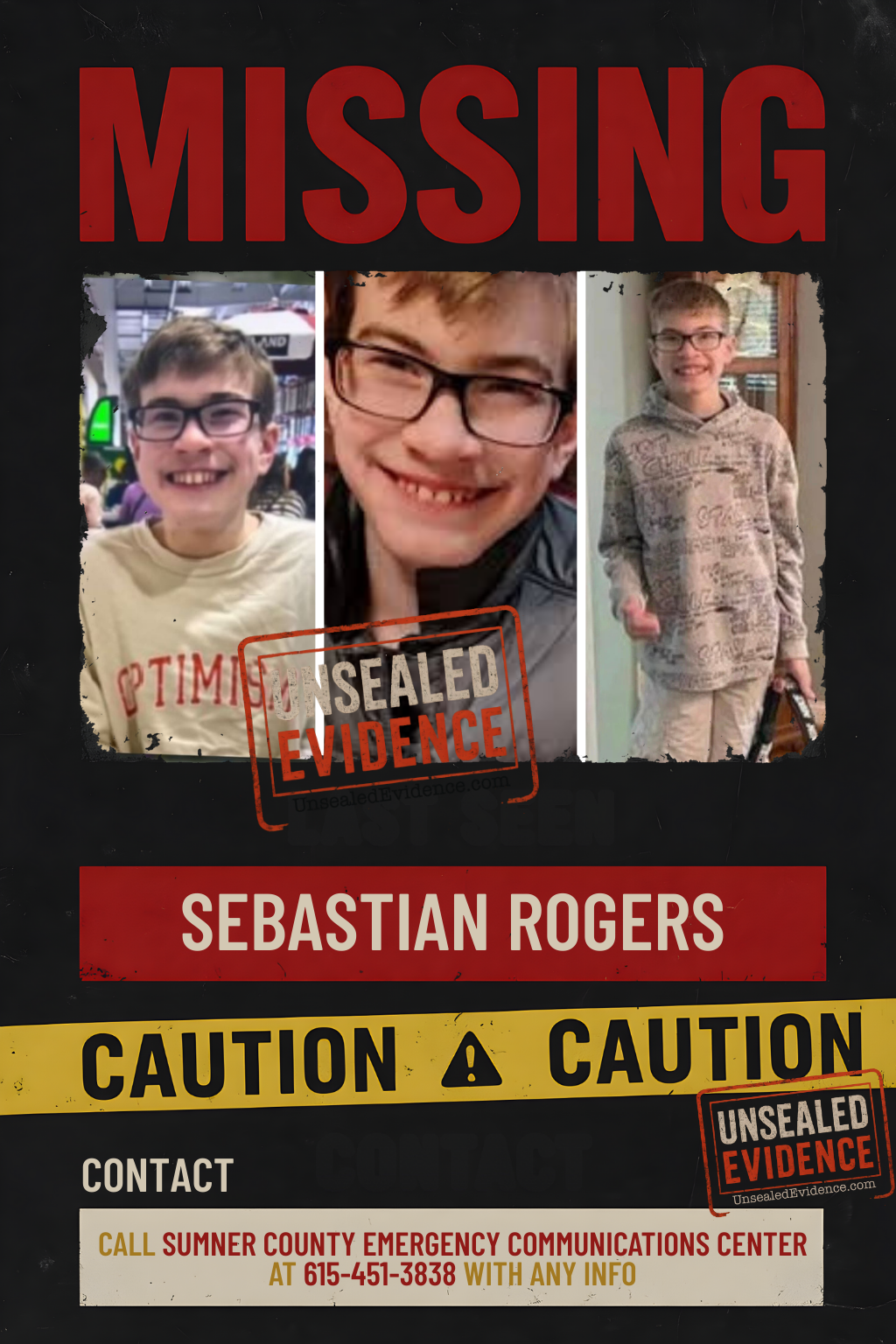
The Vanishing of Sebastian Rogers
The Vanishing of Sebastian Rogers In the hush of a Hendersonville neighborhood on February 26, 2024, the Rogers family awoke to a nightmare. Fourteen-year-old Sebastian Wayne Drak
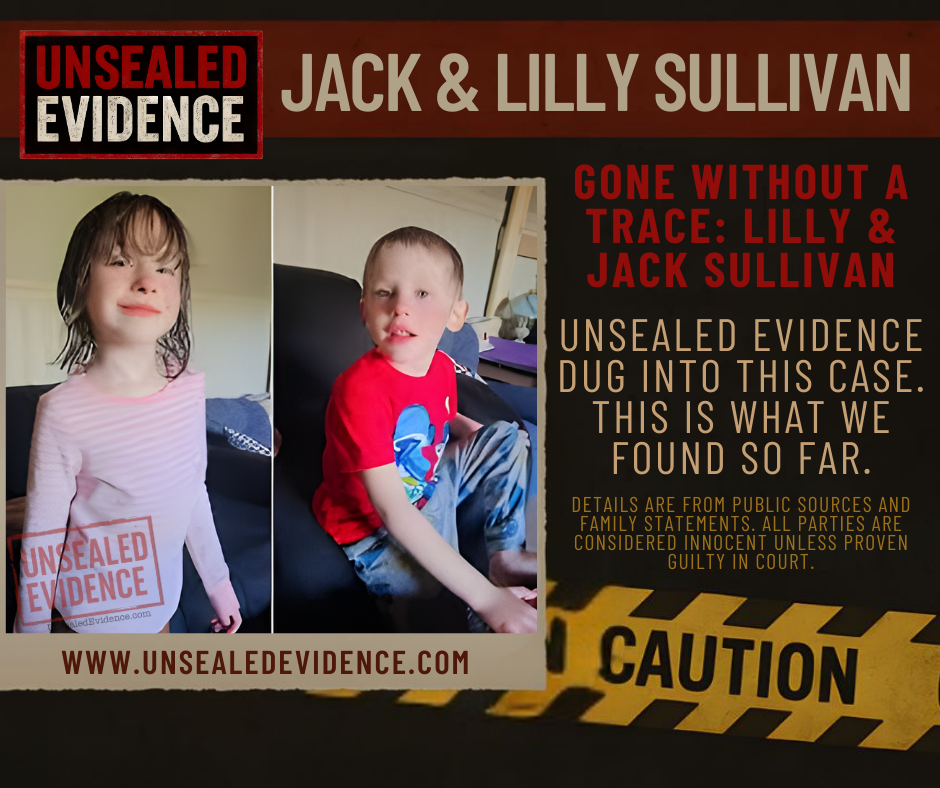
THE LOST TRAIL OF LILLY AND JACK SULLIVAN
A Quiet Morning That Never Should Have Become a Nightmare There are some cases that crack a community straight down the center—cases that make people question everything the

Christmas Eve Vanishing: The Camila Mendoza Olmos Story
Christmas Eve Vanishing: The Camila Mendoza Olmos Story Camila Mendoza Olmos, a 19-year-old college student in northwest Bexar County, Texas, disappeared on the morning of Wednesd
Behind the Locked Door: The Ty and Bryn Larson Custody Battle and the 54-Day Barricade
The Ty and Bryn Larson case became one of the most controversial and widely discussed family court stories in recent years after two Utah siblings barricaded themselves inside an u
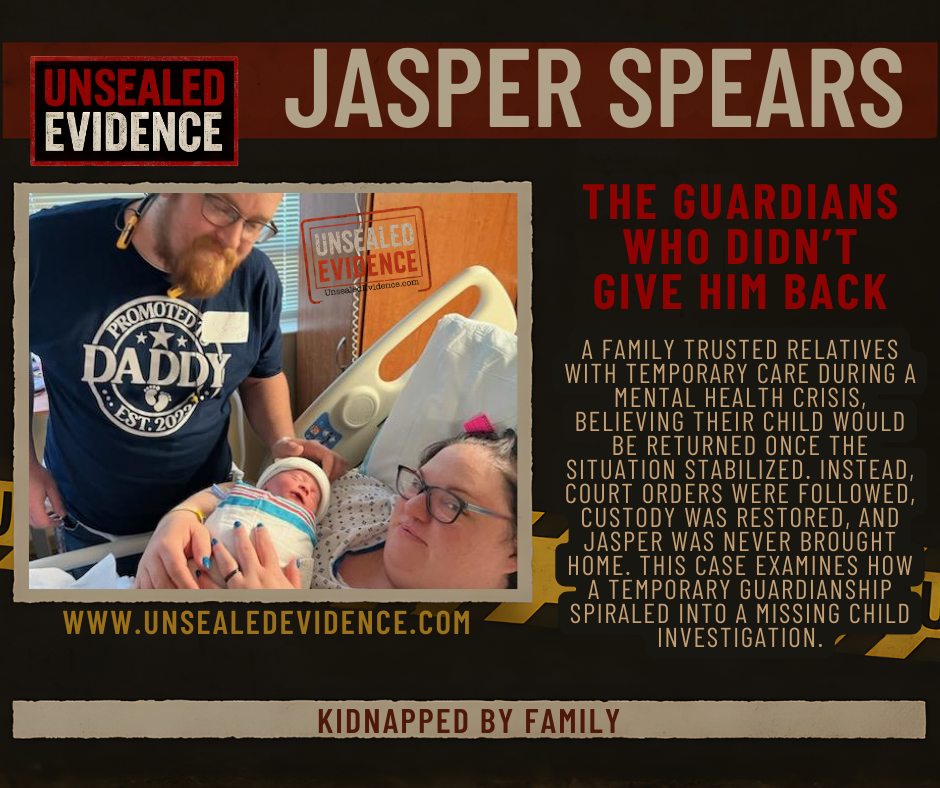
The Guardians Who Didn’t Give Him Back: Jasper Michael Spears
The Guardians Who Didn’t Give Him Back: The Disappearance of Jasper Michael Spears The Hospital Visit That Started Everything Jasper Michael Spears was born on November 6,

The Strongsville Impact: The Deaths of Dominic Russo and Davion Flanagan
In the early morning hours of July 31, 2022, a devastating crash in Strongsville left 20-year-old Dominic Russo and 19-year-old Davion Flanagan dead after a Toyota Camry driven by
The Day the Silence Broke: A Human Account of the Carly Gregg Tragedy
March 19, 2024. A Tuesday. In the quiet, unassuming town of Brandon, Mississippi, a day that began with the mundane rhythm of school and work would spiral into a vortex of horror,
The Rugrats Coat Disappearance: The Killing of Na’Ziyah Harris Without a Body
Vanished After the Bus Stop: A Detroit Afternoon That Changed Everything On January 9, 2024, a thirteen-year-old girl stepped off her school bus on Detroit’s east side, wear