KAYLEIGH SLUSHER: THE LITTLE GIRL IN THE FREEZER
A Welfare Check Reveals a Nightmare
On a quiet Saturday afternoon in Napa, California, two police officers rapped on the door of Apartment 28 with growing unease. It was February 1, 2014, and they were there to perform a welfare check on a little girl named Kayleigh Slusher. An anonymous 911 call had urged them to hurry – something about the three-year-old not being seen and possibly hurt. When the door finally creaked open, no child came running. Inside the small apartment, a heavy stillness hung in the air. The officers stepped into Kayleigh’s bedroom, and that’s when the nightmare materialized before their eyes.
Kayleigh was lying motionless on her toddler bed as if napping, but the scene was all wrong. Her skin was unnaturally pale and her lips tinged blue. She wasn’t breathing. One officer gently reached out to check for a pulse and drew back in shock – Kayleigh’s small body was cold. In fact, it was frozen. Bruises of various colors covered her arms, legs, and tiny torso. Some were fresh and angry; others were yellowing with age. The child looked as though she had endured a lifetime of hurt in just a few short years. It only took a moment for the awful truth to sink in: Kayleigh was dead, and not from any natural cause. The room, once meant for an innocent child’s dreams, now held a scene of horror that seasoned officers would later struggle to forget.
As the investigators secured the apartment, troubling clues of what had happened slowly emerged. In the kitchen stood an ordinary freezer, and inside it they found faint traces that it had recently held something far more disturbing than groceries. The evidence suggested that after Kayleigh died, someone had stored her body in the freezer for a time. Later, she had been taken out and carefully placed on her bed – as if pretending nothing had happened. It was a grotesque attempt to stage the child’s death as something peaceful, even as every bruise and the icy chill of her skin told a story of unimaginable cruelty. Napa Police quickly realized they were dealing with a murder, one made all the more chilling by the lengths taken to conceal it.
Word of the discovery spread rapidly through the police department and into the community. The officers who found Kayleigh were seen exiting the apartment in tears, shaking with anger and sorrow. Detectives processed the scene, collecting a heartbreaking array of evidence: tiny clothes, blood traces, and that now-infamous freezer. Outside, yellow crime scene tape fluttered in the evening breeze as neighbors gathered, horrified, and parents instinctively pulled their own children closer. Napa, a city better known for its tranquil vineyards and quiet suburbs, was about to learn that a monstrous crime had been hiding in its midst. And the question on everyone’s lips was the same: How could this happen to a three-year-old girl, right here in our community?
Hidden Suffering Behind Closed Doors
In the days that followed, the community would learn that Kayleigh Slusher’s life had been filled with danger long before that welfare check. Behind the closed door of Apartment 28, the little girl had been living with her mother, Sara Krueger, and Sara’s boyfriend, Ryan Scott Warner. To the outside world, Sara was a young single mom trying to raise a toddler. But inside that home, according to later accounts and courtroom framing, things were spiraling into darkness. Both Sara and Ryan were reportedly using methamphetamine in the months leading up to Kayleigh’s death. The drug use brought chaos, paranoia, and bursts of anger – and tragically, it was Kayleigh who suffered most from the fallout.
Neighbors at the apartment complex recalled how Kayleigh had been a familiar little face playing outside – a bubbly, outgoing toddler often seen giggling on the courtyard swings or chasing bubbles. But after Ryan moved in around mid-2013, those happy sightings became rare. The once-vibrant child began to appear in public less and less. When neighbors did catch glimpses of her, they noticed disturbing changes: Kayleigh looked thin, even malnourished, and bruises sometimes speckled her skin. The bright sparkle in her eyes seemed to be fading. “She lost her sparkle,” one neighbor sadly remarked later, describing how the toddler who used to smile and wave had grown quiet and withdrawn.
Family members also began sounding the alarm in the weeks before her death. There were reports that relatives contacted authorities with concerns about what was happening in that apartment. Others voiced suspicion about drug use and possible abuse. Napa police officers and child welfare workers went to the residence more than once in January 2014 to check on Kayleigh. Each time, the child remained in the home. With hindsight, those visits became painful “what if” moments – missed chances that might have changed the ending.
Later medical findings described an extensive pattern of injuries across Kayleigh’s small body. The picture that emerged was not of a single sudden tragedy, but of repeated harm over time. And in the center of it all was a child who depended entirely on the adults around her to keep her safe – adults who failed her in the most devastating way.
A Gruesome Cover-Up
Investigators later pieced together Kayleigh’s final day as a chain of suffering that ended in death. The fatal injury was described in court as severe internal trauma, consistent with a violent blow. It was not the kind of injury a toddler could simply “sleep off.” It would have caused intense pain and rapid decline. Yet instead of seeking help, the adults responsible did not bring her to a hospital. Whatever the exact sequence of that day, the outcome was the same: Kayleigh died without rescue.
What followed was a decision so chilling it became the detail that people could not forget. After Kayleigh’s death, her body was reportedly placed inside a duffel bag and stored in the household freezer for a period of time. Later, she was removed and laid on her bed. The positioning suggested an attempt to make the scene look normal, as if she had simply passed peacefully in sleep. But the cold reality of her body and the visible bruising told a different story, one of desperation and concealment rather than compassion.
A friend later entered the apartment and realized something was terribly wrong. He urged that police be called. When that did not happen, he made a choice that forced the truth into the light. That decision set the welfare check into motion – the same welfare check that would lead officers into Kayleigh’s room and change Napa forever.
Flight and Capture
By the time law enforcement arrived, Kayleigh’s mother and the boyfriend were gone. The departure looked like a scramble to outrun consequences, not a frantic search for help. As officers secured the scene and the case became a homicide investigation, a manhunt began for the two adults last known to be caring for the child.
Less than two days later, the fugitives were located in the Bay Area after a citizen reported recognizing them. Police converged quickly. The pair attempted to flee, but were arrested without incident at or near a transit station. The run ended fast, but it didn’t soften the horror of what investigators found back in Napa – or the questions about how long Kayleigh had been suffering before anyone truly intervened.
When the handcuffs clicked into place, the community felt a brief, cold relief. Yet for Kayleigh’s family, and for every neighbor who had worried quietly, the pain was only beginning. Arrests can stop further harm, but they cannot undo what already happened in that small bedroom.
An Innocent Life Stolen
Before she became the center of a tragedy, Kayleigh Jayne Slusher was a bright, affectionate little girl with a life that should have been full of ordinary childhood moments. She was born in 2010 and, by three, had the kind of energy that fills a home: laughter in the hall, tiny footsteps on the floor, a voice calling out for snacks, cartoons, or a favorite toy.
Those who loved her remembered a sweet toddler who enjoyed simple joys – coloring, cartoons, and the comfort of familiar routines. She was small enough to be scooped up easily, young enough to trust completely. And that trust is the heartbreak at the core of this case. Kayleigh didn’t have the power to leave. She didn’t have the words to explain the full reality of what was happening. She only had the hope that the adults around her would do what adults are supposed to do: protect her.
After her death, grief spilled into the streets. Vigils were held. People brought stuffed animals and candles, trying to create softness around a story that had none. It was the community’s way of saying what Kayleigh should have heard every day: you mattered, and you were loved.
Aftermath and Accountability
In the months and years that followed, the legal process unfolded with the slow weight typical of major homicide cases. Prosecutors charged both Sara Krueger and Ryan Scott Warner, focusing on murder and child abuse resulting in death. The case was built around medical findings, crime scene evidence, and the defendants’ actions after Kayleigh died. The details presented in court were difficult to hear, even for those who work in the system every day.
Eventually, juries found both defendants guilty. The court’s findings reflected not just a death, but a pattern of prolonged harm. Sentencing placed both behind bars for decades. Over time, changes in state law and appellate review altered parts of the sentencing framework, creating additional court hearings and renewed pain for Kayleigh’s family as the case resurfaced again and again. Even when a conviction stands, the legal system can revisit elements of punishment, and that reality can feel like reopening a wound.
Outside the criminal case, another question lingered: could this have been prevented? There were reports of welfare checks and concerns raised before Kayleigh died. In the wake of public outrage, agencies faced scrutiny for what happened and what didn’t happen. Kayleigh’s family pursued accountability through civil court, and a settlement later underscored how deeply the community wanted answers and change.
For many in Napa, Kayleigh’s name became more than a case file. It became a warning, a reminder, and a call to take child welfare concerns seriously the first time – and the tenth time. Her story forced a community to look hard at the spaces between “concern” and “action,” and what can happen when those spaces stay open too long.
Official Findings
Investigators and court proceedings confirmed Kayleigh’s death was a homicide resulting from severe physical abuse. Medical findings described extensive injuries across her body and fatal internal trauma. The injuries were presented as consistent with repeated harm rather than a single accidental event. The cold condition of her body at discovery, along with other evidence discussed in court, supported the conclusion that her body had been stored in a freezer for a period of time after death.
Statements and behaviors after the death also became key. Instead of seeking emergency help, the adults involved allegedly attempted to conceal what happened and then fled the area before police arrived. The fact that they left the home ahead of the welfare check, and were later captured after a public tip, was presented as part of the narrative of consciousness of guilt.
While there were early suspicions and public speculation around additional forms of abuse, the case’s prosecution focused on what could be proven in court through official findings and admissible evidence. The end result was clear: the legal system concluded Kayleigh’s death was not an accident, and that those responsible were held criminally accountable.
Lingering Questions
- Could Kayleigh have been saved if intervention had happened sooner, especially after repeated concerns were raised?
- Why did multiple welfare-related contacts not result in Kayleigh being removed from the home for her safety?
- What exactly happened in the hours leading up to the fatal injury, and what triggered the violence that ended her life?
- Were there warning signs in the home that were minimized or missed, and what policies allowed that to happen?
- As future parole eligibility becomes possible decades later, will either convicted person ever provide a full, honest account of what happened?
- Have procedural changes since this case been enough to prevent similar tragedies, or do the same gaps still exist?
Key People in Kayleigh’s Case
Kayleigh Slusher - Victim - A three-year-old child whose life ended in extreme violence and whose story continues to shape community conversations about child protection.
Sara Krueger - Mother - Kayleigh’s mother, convicted in connection with Kayleigh’s death and held responsible for failing to protect her and participating in the events that led to her murder.
Ryan Scott Warner - Mother’s Boyfriend - Sara’s boyfriend at the time, convicted in connection with Kayleigh’s death and identified as a key participant in the abuse.
Jason Slusher - Father - Kayleigh’s biological father, who later became central in seeking accountability and justice after her death.
Robin Slusher - Grandmother - Kayleigh’s paternal grandmother, who publicly mourned Kayleigh and supported efforts to hold systems accountable.
John Krueger - Grandfather - Kayleigh’s maternal grandfather, who spoke publicly about the devastation of losing Kayleigh.
Napa Police and Child Welfare Responders - Agencies - The officials who handled welfare-related contacts before the murder and the homicide investigation after Kayleigh was found.
Concerned Friend - Witness - A person connected to the household who recognized the seriousness of the situation and contacted law enforcement, triggering the welfare check that exposed the crime.
Continue Investigating

Christmas Eve Vanishing: The Camila Mendoza Olmos Story
Christmas Eve Vanishing: The Camila Mendoza Olmos Story Camila Mendoza Olmos, a 19-year-old college student in northwest Bexar County, Texas, disappeared on the morning of Wednesd
Behind the Locked Door: The Ty and Bryn Larson Custody Battle and the 54-Day Barricade
The Ty and Bryn Larson case became one of the most controversial and widely discussed family court stories in recent years after two Utah siblings barricaded themselves inside an u
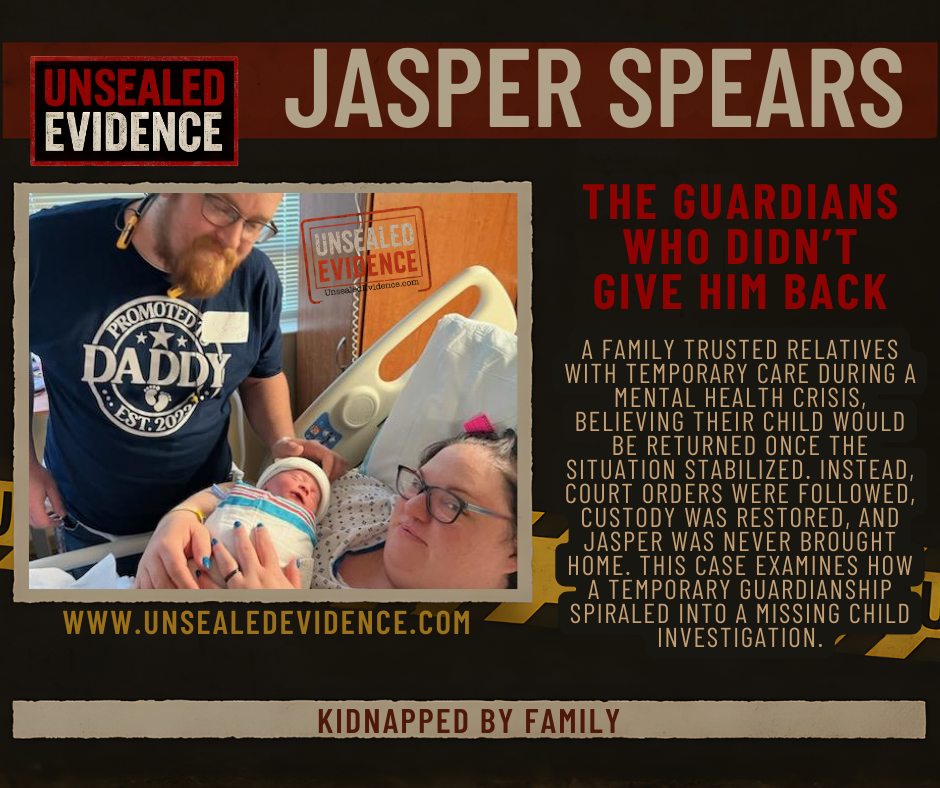
The Guardians Who Didn’t Give Him Back: Jasper Michael Spears
The Guardians Who Didn’t Give Him Back: The Disappearance of Jasper Michael Spears The Hospital Visit That Started Everything Jasper Michael Spears was born on November 6,
The Strongsville Impact: The Deaths of Dominic Russo and Davion Flanagan
In the early morning hours of July 31, 2022, a devastating crash in Strongsville left 20-year-old Dominic Russo and 19-year-old Davion Flanagan dead after a Toyota Camry driven by
The Day the Silence Broke: A Human Account of the Carly Gregg Tragedy
March 19, 2024. A Tuesday. In the quiet, unassuming town of Brandon, Mississippi, a day that began with the mundane rhythm of school and work would spiral into a vortex of horror,
The Rugrats Coat Disappearance: The Killing of Na’Ziyah Harris Without a Body
Vanished After the Bus Stop: A Detroit Afternoon That Changed Everything On January 9, 2024, a thirteen-year-old girl stepped off her school bus on Detroit’s east side, wear
Dance Floor Deception: The Washington, Illinois Case of Robyn Polston and the Newborn at the Center of It All
The Night It Began at a School Dance In May 2023, inside a junior high school gymnasium in Washington, Illinois, colored lights reflected off polished floors as students gathered

Taken at Sears: The Abduction That Changed America Forever
Forensic and Socio-Legislative Analysis of the Adam Walsh Abduction and Its Impact on American Jurisprudence The abduction and murder of six-year-old Adam Walsh on Jul